Greek mathematician active in Alexandria around 300 BCE, compiler of the thirteen books of the Elements and author of the Data, Optics and Phaenomena. Almost nothing is known of his life; the main source is Proclus, writing some 750 years later.
I venture to think that a hundred years from now everyone will study it, and will then feel they came to it late.
—— Xu Guangqi, Miscellaneous Remarks on the Jihe yuanben (1607)
History
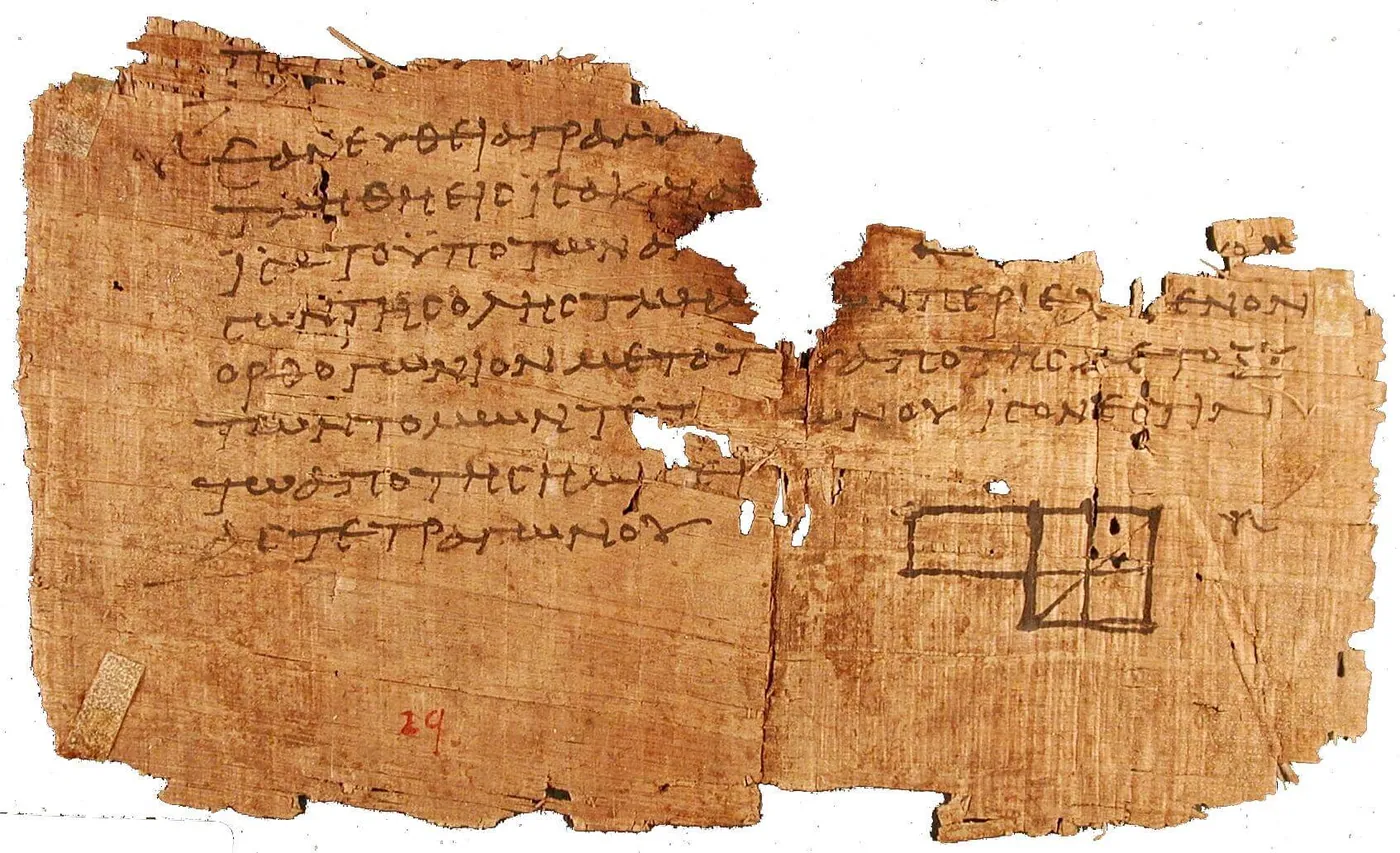
Almost nothing is recorded of Euclid's life. Proclus, commenting on Book I of the Elements in the fifth century CE, inferred that he flourished under Ptolemy I, after Plato's pupils and before Archimedes and Eratosthenes, resting the inference on a sentence in Archimedes that mentions Euclid and that some scholars regard as a later interpolation. Proclus also reports his reply to Ptolemy that there is no royal road to geometry. Stobaeus tells of a student who, having learned the first theorem, asked what he would gain by it; Euclid told his slave to give the man three obols, "since he must make gain out of what he learns". From the Middle Ages into the sixteenth century he was often confused with Euclid of Megara, a pupil of Socrates. His On Divisions of Figures survives only in Arabic. A papyrus scrap of the Elements from Oxyrhynchus dates from about 100 CE, and the book was first printed at Venice in 1482. It reached China more than once. In 1273 the Yuan dynasty's Northern Observatory listed fifteen volumes of a work generally identified as an Arabic or Persian Euclid, never translated; in 1607 Matteo Ricci and Xu Guangqi translated the first six books from Clavius's Latin edition, and in 1857 Alexander Wylie and Li Shanlan rendered the other nine, printed together with the first six at Nanjing in 1865 under Zeng Guofan's patronage.
Connections
Causes1
- Ptolemy I Soterpatronized · disputedAccording to Proclus, Euclid flourished in Alexandria under Ptolemy I
Consequences1
- Euclid's ElementscontributedCompiled the thirteen books of the Elements
Sources
- Thomas L. Heath, The Thirteen Books of Euclid's Elements, vol. 1: Introduction and Books I, II (1908)
- Proclus, A Commentary on the First Book of Euclid's Elements (trans. Glenn R. Morrow) (1970)
- Peter M. Engelfriet, Euclid in China: The Genesis of the First Chinese Translation of Euclid's Elements, Books I-VI (Jihe yuanben, Beijing, 1607) and its Reception up to 1723 (1998)
- 利玛窦、徐光启 译, 几何原本(前六卷,附徐光启《几何原本杂议》) (1607)
Open questionspartly uncertain
- Euclid's dates and place of origin are unknown.
- The passage in Archimedes on which Proclus based his dating may be a later interpolation.
- The "no royal road" and "three obols" stories are both late anecdotes, and the first also exists in a version in which Menaechmus says it to Alexander.
- The work listed in a Yuan-dynasty catalogue as Sibo suanfa duanshu is generally identified with the Elements, but it does not survive.
- The last nine books were first printed in 1857, but the printing blocks were soon destroyed, and the 1865 Nanjing edition became the standard complete text.
Why it matters
Everything known about Euclid travelled with the manuscripts and translations of the Elements, gathering anecdotes and confusions along the way. The book's transmission depended on an unbroken chain of copying, commentary, translation and teaching, and hardly at all on its author's biography: in Baghdad, Toledo, Venice and Beijing, translators and editors each remade the book into a textbook usable at home. In 1607 Xu Guangqi predicted that within a century everyone would study it. The remaining nine books waited another 250 years for a Chinese version; under the Qing the work was studied mainly by a few calendrical experts and at court, and geometry became an ordinary school subject only with the new-style schools of the late Qing. Whether a book takes root depends on schools, examinations and professions that need it, and China in 1607 had none of them for geometry.