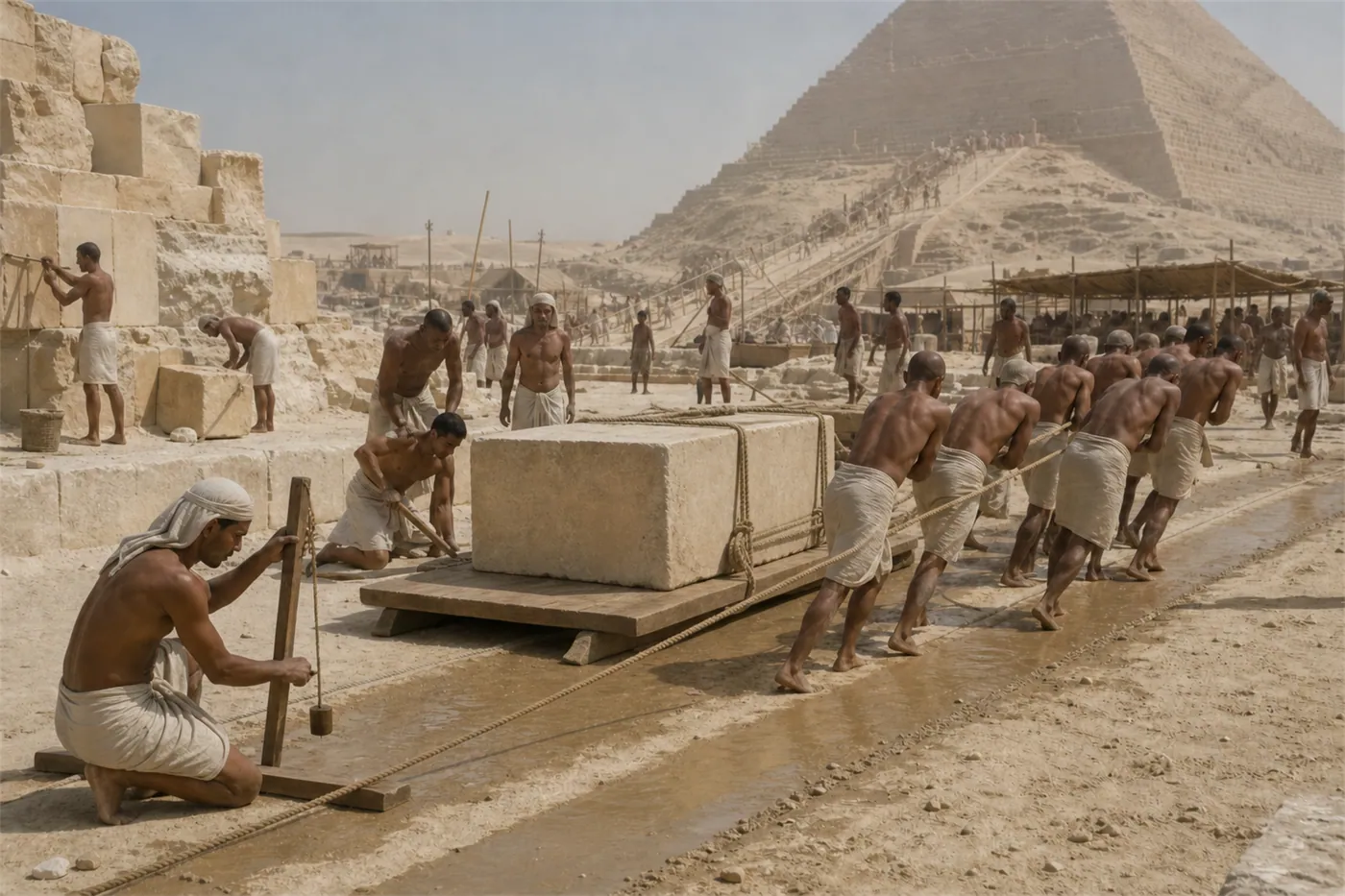
Three royal tombs of the Fourth Dynasty on the Giza plateau southwest of Cairo, built about 2600–2500 BCE. The pyramid of Khufu stood some 146.6 metres high and used roughly 2.3 million blocks, remaining the tallest structure on earth for nearly four millennia. Its technical difficulty is usually misplaced: the hard part was not moving heavy stone but organizing—orientation true to within minutes of arc, level maintained course by course, and decades of quarrying, hauling, and feeding rotating gangs. Excavation of the builders' settlement and harbour works from the late twentieth century onward, together with the diary of Merer found at Wadi al-Jarf, recording an overseer's daily shipments of Tura limestone, has made the old picture of slave hordes untenable: the evidence points to rotating peasant levies, a standing corps of skilled workers, and a fairly complete system of rations.
Man fears time, but time fears the pyramids.
—— Arabic proverb (widely quoted; earliest source untraced)
History
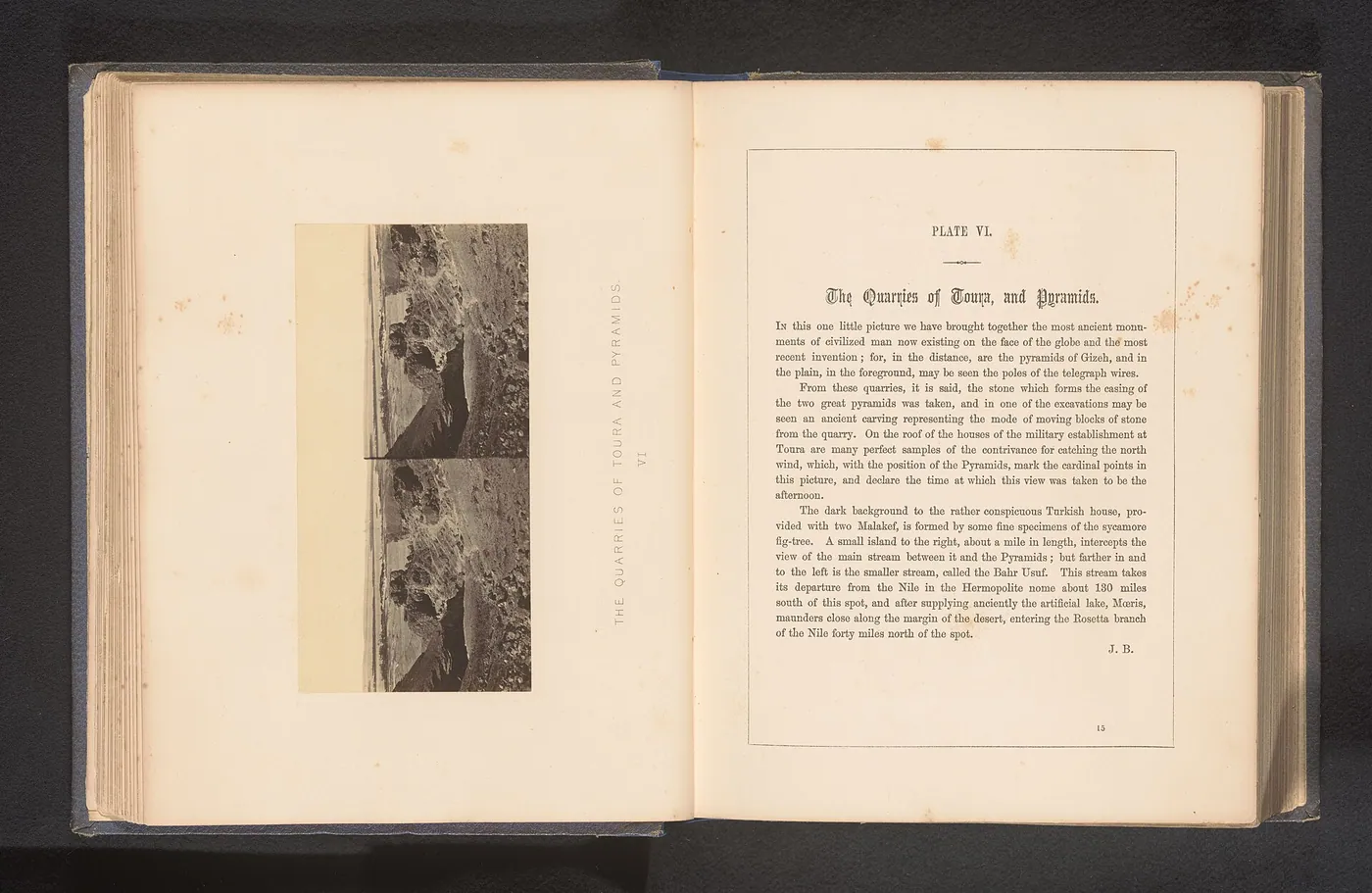
The three pyramids at Giza belong to the Fourth Dynasty of the Old Kingdom, raised in turn for Khufu, Khafre, and Menkaure between about 2600 and 2500 BCE. Khufu's has a base some 230 metres to a side, its four sides differing by less than 20 centimetres; the base is level to about 2 centimetres across the whole field; and the sides face the cardinal points to within a quarter of a degree of true north—accuracies achieved with cord, stakes, water channels, and observation of the stars, and the hardest part of the work to account for. The bulk of the stone was limestone quarried on the spot, the casing fine limestone from Tura on the east bank, and the granite beams of the king's chamber came from Aswan, eight hundred kilometres upstream. Among the papyri found in 2013 at Wadi al-Jarf on the Red Sea is the working diary of an overseer named Merer, who led a gang of some forty men by boat between Tura and Giza, several days to the round trip, recorded as tidily as a ledger. That document, together with the builders' settlement excavated from the 1990s (bakeries, breweries, heaps of fish and cattle bone, dormitories and overseers' quarters, and a substantial cemetery of workmen), yields a picture of rotating peasant levies and a standing corps of skilled men, fed by the state on bread, beer, and meat, the craftsmen buried near the king they had built for. Herodotus's hundred thousand men toiling for twenty years, written down two millennia later, is hearsay and not record.
Connections
Echoes2
- The Grand CanalechoesTwo state mobilizations over three thousand years apart, whose technical legacy lies in organizing survey, scheduling, logistics, and accounting rather than in the monument itself
- The Pharos of AlexandriaechoesTwo of the Seven Wonders of the ancient world, both in Egypt
Sources
- Mark Lehner, The Complete Pyramids
- Mark Lehner & Zahi Hawass, Giza and the Pyramids: The Definitive History
- Pierre Tallet, Les papyrus de la mer Rouge I: Le «journal de Merer»
- Great Pyramid of Giza
Open questionswell attested
- The total of "about 2.3 million" blocks is the commonly cited order of magnitude estimated from volume, and estimates range from 2 million to 2.4 million.
- Views on the length of construction and the size of the workforce vary widely: Herodotus's "100,000 men for twenty years" is later hearsay, and modern estimates mostly put the number on site at any one time between a few thousand and over 20,000.
- The exact method of moving the blocks (straight ramp, spiral ramp, internal ramp, or levering them up course by course) is still unresolved, so no single scheme is treated as settled.
- That the pyramids were not built by slaves is the mainstream view supported by current archaeological evidence, but how to characterize the work between "rotating corvée" and "voluntary labour" is still open to discussion.
Why it matters
In popular culture the pyramids have long been an impossible puzzle, and the mystery has a social source: it assumes the ancients cannot have done this, and so another explanation must be found. Yet what deserves astonishment lies on the best-evidenced side. Lifting a two-and-a-half-tonne block, given ramps, sledges, water, and enough people, is a solvable problem. Placing two million such blocks where each belongs across some twenty years, while ten thousand people eat daily, are assigned work, are accounted for, and are supervised: that is the astonishing achievement. The pyramid is first of all an administrative accomplishment: it required survey and bookkeeping, the fitting of work seasons to the Nile's flood and the farming year, and a ration system able to deliver bread and beer accurately to every gang. Merer's diary is precious exactly because it is one page of that system's running account—among the earliest documents of project management humanity has left. A second layer concerns the form of the mega-project itself: from Giza to the Grand Canal, the technical legacy of great mobilizations lies less in the product than in the process (survey, scheduling, logistics, record-keeping), capacities that, once built, can be turned to other ends, the monument being only their most conspicuous by-product. A third layer requires restraint. To call the pyramids the blood and tears of slaves is wrong; to call them the pride of labour may not be right either. A rotating levy is an obligation, not a choice, and the height of its organization and the depth of its command over individuals were always two sides of one thing.