Mathematician and engineer of Syracuse (c. 287–212 BCE). He proved the law of the lever and the principle of buoyancy, trapped π between 3 10/71 and 3 1/7, and was killed when Rome took the city.
Give me a place to stand on, and I can move the earth.
—— Attributed to Archimedes by Pappus of Alexandria, Collection VIII.11 (early 4th century CE; ed. Hultsch, p. 1060), trans. T. L. Heath
History
The law of the lever states that two weights balance at distances from the fulcrum inversely proportional to their weights. In On the Equilibrium of Planes Archimedes proved it from a few postulates, the earliest surviving axiomatic statics. Born in Syracuse around 287 BCE, the son of the astronomer Phidias, he spent most of his life there, close to King Hieron II. On Floating Bodies showed that a body immersed in a fluid loses weight equal to the weight of the fluid it displaces; Measurement of a Circle used 96-sided polygons to trap π between 3 10/71 and 3 1/7; Quadrature of the Parabola found a parabolic segment to be 4/3 of its inscribed triangle; The Sand Reckoner devised a notation for numbers large enough to count the grains filling the cosmos, and preserved Aristarchus' hypothesis of a moving Earth. When Rome besieged Syracuse from 214 BCE, Polybius, Livy and Plutarch describe his catapults and an iron "claw" that hoisted ships by the prow; the city fell in 212 BCE and a Roman soldier killed him. Cicero adds that the Roman commander Marcellus carried home a sphere he had made to show the motions of sun, moon and planets. In 75 BCE Cicero, then quaestor in Sicily, found his neglected tomb, marked with a sphere inscribed in a cylinder. The "Eureka" bath comes from Vitruvius nearly two centuries later; the burning mirrors are later still.
Connections
Causes1
- Euclid's ElementsinspiresArchimedes built his proofs on the system of the Elements
Consequences1
- Galileo GalileiinspiresGalileo's early La Bilancetta took Archimedes as its model
Echoes2
- EratosthenesechoesArchimedes addressed The Method to Eratosthenes
- The Antikythera MechanismechoesCicero records a geared sphere made by Archimedes and taken to Rome by Marcellus
Sources
- T. L. Heath (ed. and trans.), The Works of Archimedes (with the supplement The Method of Archimedes, 1912) (1897)
- E. J. Dijksterhuis, trans. C. Dikshoorn, bibliographic essay by Wilbur R. Knorr, Archimedes (1987)
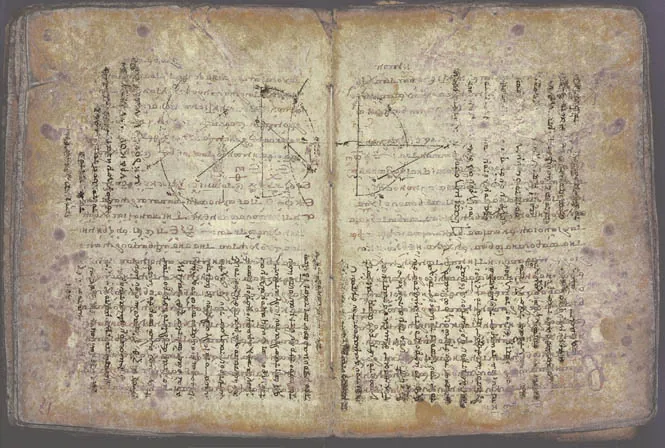
- Reviel Netz, William Noel, Natalie Tchernetska and Nigel Wilson (eds.), The Archimedes Palimpsest (2 vols.) (2011)
Open questionswell attested
- His year of birth is calculated from Tzetzes' statement that he lived to the age of seventy-five.
- The details of his machines for defending the city come from historians on the Roman side and are hard to verify.
- The famous saying about the lever comes from Pappus, who reports it as hearsay, and does not appear in Archimedes' own works.
- The burning of ships with mirrors is a later legend.
Why it matters
Archimedes matters because traffic between machine and proof ran both ways in his work. Lever and buoyancy, long known to craftsmen, became theorems. Conversely, The Method, addressed to Eratosthenes, explains how he first found areas and volumes by "weighing" thin slices of figures on an imaginary balance and then proved the results by exhaustion, keeping investigation and demonstration strictly apart. The treatise survived in a single tenth-century copy, overwritten as a prayer book in the thirteenth century; Heiberg recognized it in 1906, and multispectral imaging in 1999–2008 recovered much more. Plutarch's sage who scorned every art serving the needs of life says more about Plutarch's Platonism than about the author of The Method. The famous boast, as Pappus reports it, mentions neither lever nor fulcrum; it concerns moving a given weight with a given force. Galileo took him as a model in La Bilancetta (1586), and the habit of settling physical questions by mathematical proof runs back to him.