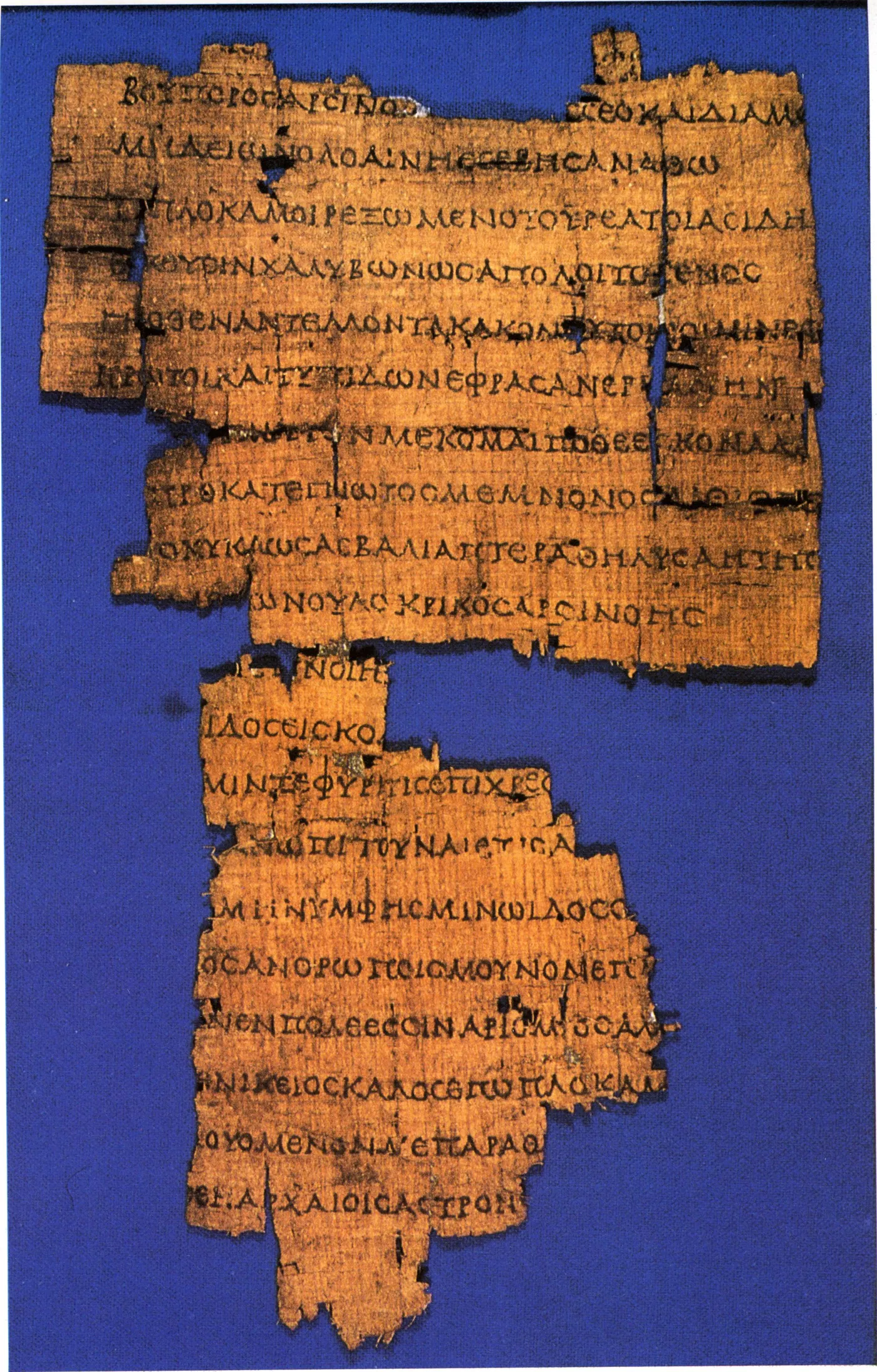
The Pinakes ("Tables," c. 3rd c. BCE), compiled by the Library of Alexandria scholar Callimachus, which listed the collection's authors and works by category with brief biographies and opening lines, in 120 books. It is regarded as the world's earliest library catalogue and the beginning of bibliography—when a collection grows too large to find anything in, retrieval itself becomes a technology.
A big book is a big evil.
—— Callimachus, fr. 465 Pfeiffer (μέγα βιβλίον μέγα κακόν)
History
The Library of Alexandria held books by the hundred thousand, and with them came a problem no one had seriously faced: with so many books, how does one know what exists, or find it? The poet-scholar Callimachus (c. 305–240 BCE) answered with the Pinakes ("Tables"), 120 books that listed the collection's authors and works, arranged by category (poetry, rhetoric, law, medicine, history…), each author given a short life, each work recorded with its opening line and number of lines for identification. This is generally regarded as the world's first library catalogue and the beginning of bibliography. It produced no new knowledge, but made existing knowledge retrievable—and retrievability is the precondition for knowledge being used at all.
Connections
Causes2
- The Library of AlexandriaenablesGave rise to the science of cataloguing
- Ptolemy II PhiladelphuspatronizedCallimachus compiled the Pinakes in his reign
Sources
- Alan Cameron, Callimachus and His Critics
- Roy MacLeod (ed.), The Library of Alexandria
- Pinakes
Open questionspartly uncertain
- That the Pinakes ran to 120 books arranged by category rests on ancient testimony.
- The original is lost, and its contents have been reconstructed from later citations.
- Calling it the "earliest catalogue" is the usual verdict, but not an undisputed one.
Why it matters
Cataloguing is easily overlooked but has strong credentials in the history of technology: it reminds us that organizing information is itself a technology, no less important than producing it. It was the Library that gave rise to cataloguing, since the sheer mass of the collection forced a method of retrieval. Callimachus's line "a big book is a big evil" was a jibe at bloated epic, but from his mouth it turns ironic: the man who compiled a 120-book catalogue complains that others' books are too long. Behind the complaint lies a real problem still unsolved—the more information there is, the costlier it is to find what one needs. From the Pinakes to the card catalogue to the search engine, humanity has been answering the same question.