Italian mathematician who established by experiment that a falling body's distance grows as the square of the time, found Jupiter's moons and the phases of Venus, and was condemned by the Inquisition in 1633 for defending Copernicus.
Well, Sarsi, that is not how matters stand. Philosophy is written in this grand book, the universe, which stands continually open to our gaze. ... It is written in the language of mathematics, and its characters are triangles, circles, and other geometric figures without which it is humanly impossible to understand a single word of it; without these, one wanders about in a dark labyrinth.
—— Galileo, Il Saggiatore (The Assayer), section 6 (Rome, 1623), trans. Stillman Drake, Discoveries and Opinions of Galileo (1957), pp. 237–38
History
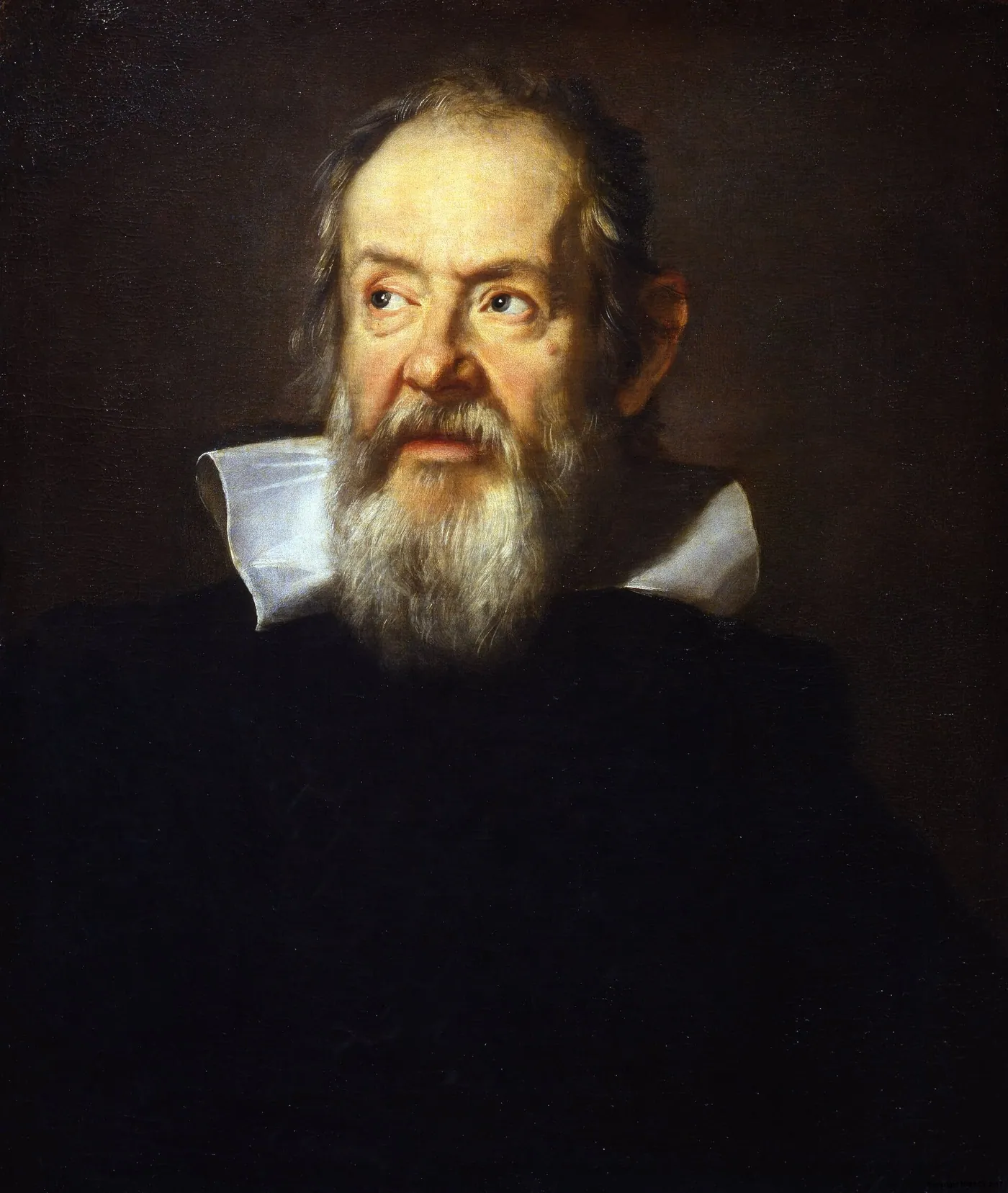
Galileo was born in Pisa in 1564, abandoned medicine for mathematics, and in 1586 wrote La Bilancetta, reconstructing how Archimedes might have tested a crown with a balance in water. He taught mathematics at Pisa from 1589 and at Padua from 1592 to 1610, studying pendulums and falling bodies; by about 1604 he had concluded that a body falling from rest covers distances proportional to the square of the elapsed time. His Two New Sciences (Leiden, 1638) describes the check: a bronze ball rolled down a parchment-lined groove some twelve cubits long, timed by weighing the water that ran from a vessel during each descent, repeated, the text says, a full hundred times. In 1609 he built his own telescope; Sidereus Nuncius (1610) presented Jupiter's moons to the Medici and won him the post of chief mathematician and philosopher to the Grand Duke of Tuscany. In 1616 the Congregation of the Index declared the Earth's motion contrary to Scripture, and Cardinal Bellarmine warned him to abandon it. His Dialogue Concerning the Two Chief World Systems (1632) brought him before the Inquisition; on 22 June 1633 he was found "vehemently suspected of heresy" and abjured, and spent the rest of his life under house arrest, first in Siena and then at Arcetri, dying in 1642. The Leaning Tower demonstration comes from his pupil Viviani's memoir, and "Eppur si muove" first appears in print in 1757; neither has contemporary support.
Connections
Causes2
- ArchimedesinspiresGalileo's early La Bilancetta took Archimedes as its model
- HeliocentrisminspiresGalileo's defence of heliocentrism ended in his trial
Consequences4
- The TelescopecontributedBuilt his own in 1609 and was the first to turn it systematically on the sky
- HeliocentrismcontributedOffered the phases of Venus and the moons of Jupiter as evidence
- Universal GravitationenablesHis kinematics of falling and projected bodies passed to Newton
- The Mechanical PhilosophyinspiresGalileo held that philosophy is written in the great book of the universe, in the language of mathematics
Sources
- Galileo Galilei, trans. Stillman Drake, Discoveries and Opinions of Galileo (1957)
- Stillman Drake, Galileo at Work: His Scientific Biography (1978)
- Maurice A. Finocchiaro, The Galileo Affair: A Documentary History (1989)
- J. L. Heilbron, Galileo (2010)
Open questionswell attested
- The date at which he arrived at the times-squared law is inferred from a letter to Paolo Sarpi of 1604.
- Scholars debate whether the inclined-plane experiments were as precise as his book says and whether they were repeated a hundred times.
- That Urban VIII was angered by the character of Simplicio is a common explanation, but his motives are hard to establish.
- Neither the Leaning Tower of Pisa experiment nor the phrase "And yet it moves" has contemporary evidence behind it.
- The wording in The Assayer is "Philosophy is written in this grand book, the universe"; "the book of nature is written in mathematics" is a later paraphrase.
Why it matters
Galileo's method was to idealize motion and then measure it. The inclined plane slowed a fall until it could be timed, air resistance was set aside as a disturbance, and the resulting times-squared law and parabolic path of projectiles became starting points for Newton. In astronomy his telescope damaged Aristotle's heavens without proving that the Earth moves: the tides he offered in the Dialogue as decisive evidence were wrongly explained, and he never adopted Kepler's ellipses. The trial of 1633 is often told as science against religion. It also turned on who had the authority to interpret Scripture, on Counter-Reformation politics, and on the anger of Urban VIII, whose own argument the book had put in the mouth of the simple-minded Simplicio. In 1992 John Paul II acknowledged that the theologians who condemned Galileo had erred.