German astronomer who, working from Tycho Brahe's observations, published the three laws of planetary motion (1609, 1619) and replaced the ancient circles with ellipses; in optics he explained how the eye forms an inverted image on the retina.
The die is cast, and I am writing the book—whether to be read by my contemporaries or by posterity matters not. Let it await its reader for a hundred years, if God Himself has been ready for His contemplator for six thousand years.
—— Kepler, Harmonices Mundi, Book V, proem (Linz, 1619), trans. Charles Glenn Wallis (1939)
History
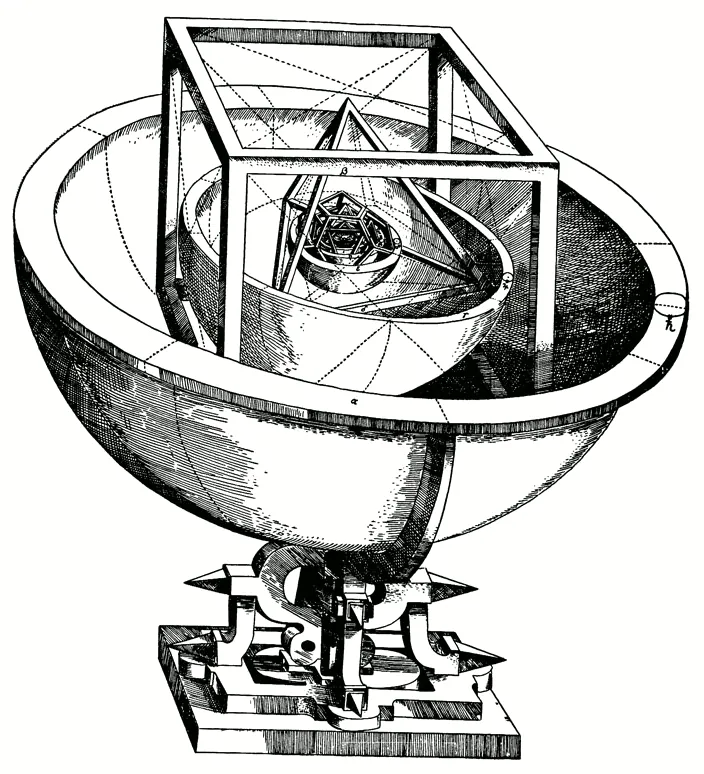
Kepler was born in 1571 at Weil der Stadt in Württemberg and learned the Copernican system from Michael Maestlin at Tübingen. While teaching at Graz he published Mysterium Cosmographicum (1596), which claimed that the five regular solids fit exactly between the spheres of the six planets; it was among the first books after De revolutionibus to defend the moving Earth in print. In 1600 he joined Tycho Brahe, imperial mathematician to Rudolf II in Prague, and on Tycho's death in 1601 succeeded him and inherited more than two decades of observations. His best circular model for Mars, the "vicarious hypothesis", still missed Tycho's positions by eight minutes of arc, so he gave up the circle. Astronomia nova (1609) put Mars on an ellipse with the Sun at one focus, stated that the line from Sun to planet sweeps out equal areas in equal times, and looked for a physical cause in a quasi-magnetic force issuing from the Sun. In 1618 he found that the squares of the periods are as the cubes of the mean distances, published in Harmonices Mundi (1619). In optics he explained the inverted image on the retina (1604) and the theory of the telescope (Dioptrice, 1611). From 1615 to 1621 he defended his mother against a charge of witchcraft and won her release. The Rudolphine Tables were printed at Ulm in 1627, and he died at Regensburg in 1630.
Connections
Causes2
- Optics (Ibn al-Haytham)inspiresKepler's optics of 1604 continued the Alhazen–Witelo tradition
- HeliocentrisminspiresKepler was among the first astronomers to defend heliocentrism in print
Consequences2
- Universal GravitationenablesNewton derived the inverse-square force from Kepler's laws
- The TelescopecontributedHis Dioptrice (1611) gave the optical theory and the Keplerian design
Sources
- Max Caspar, trans. C. Doris Hellman, Kepler (1959)
- James R. Voelkel, The Composition of Kepler's Astronomia Nova (2001)
- Johannes Kepler, trans. E. J. Aiton, A. M. Duncan and J. V. Field, The Harmony of the World (translation of Harmonices Mundi) (1997)
- Ulinka Rublack, The Astronomer and the Witch: Johannes Kepler's Fight for His Mother (2015)
Open questionswell attested
- Whether Kepler's work counts as "one of the first works to defend heliocentrism publicly" depends on how Rheticus, Digges and others are counted.
- The dates of the discovery of the third law (8 March and 15 May 1618) rest solely on Kepler's own account.
- Kepler was involved in a dispute with Tycho Brahe's heirs over the ownership of Tycho's observational data.
Why it matters
Kepler asked astronomy to explain why the planets move as they do, rather than merely to combine circles that fit their positions; the full title of Astronomia nova calls it an astronomy "based on causes, or celestial physics". His dynamics was wrong, but the ellipse and the area law held. The Rudolphine Tables built on them predicted a transit of Mercury for 7 November 1631, and Gassendi saw it from Paris on the day. The nested solids and the music of the spheres, often filed under mysticism, came from the same conviction as his refusal to ignore eight minutes of arc: the Creator had built the world on geometry, so errors mattered. The laws won few converts at first, and Galileo never adopted the ellipse. Only when Newton derived an inverse-square force from them did the three rules become consequences of a single cause.