The theory of light and vision established by Ibn al-Haytham (c. 965–1040) in the Book of Optics (c. 1011–1021). By experiment and geometrical argument he rejected the dominant Greek doctrine that vision proceeds from rays leaving the eye, establishing instead that sight arises from light entering the eye from objects; he studied the pinhole image, refraction, reflection, and spherical mirrors systematically, and made it a principle that contested claims must be settled by experiment. The Latin De aspectibus deeply influenced Bacon, Witelo, and Kepler.
The seeker after truth is not one who studies the writings of the ancients and, following his natural disposition, puts his trust in them, but rather the one who suspects his faith in them and questions what he gathers from them.
—— Ibn al-Haytham, Doubts Concerning Ptolemy (al-Shukūk ʿalā Baṭlamyūs)
History
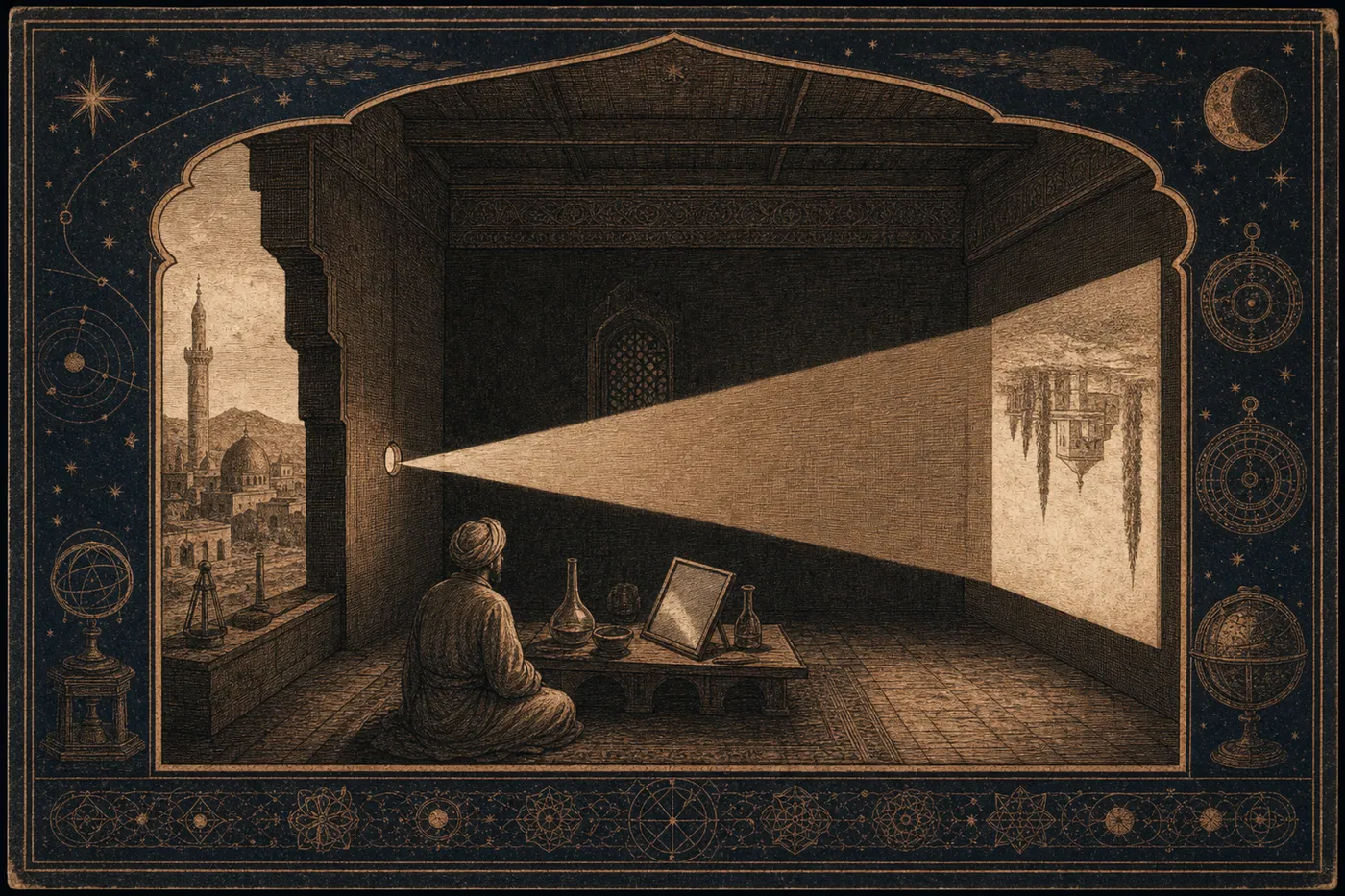
Greek optics held two opposed traditions: Euclid and Ptolemy had rays issuing from the eye to touch objects (extramission), while the Aristotelian line had the medium convey a form of the object. Ibn al-Haytham's Book of Optics settled the matter. If vision were caused by something emitted from the eye, he argued, then on looking at the stars the eye would have to reach the infinitely distant in an instant, which is not credible; and physiological facts (the pain of bright light, the afterimage of prolonged looking) show that incoming light acts upon the eye. He observed the eclipsed sun through a pinhole in a darkened chamber, divided beams with straight edges, studied how refraction angles change in water and glass, and brought rectilinear propagation, the law of reflection, and refraction under geometrical treatment. On method he insisted repeatedly: where a claim is contested, test it by controlled trial (iʿtibār), then demonstrate it mathematically. Translated into Latin around the early thirteenth century as De aspectibus, the work let Roger Bacon, Pecham, and Witelo rebuild European optics; Kepler was still working within this tradition when he treated the retinal image in 1604. As for how he came to write undisturbed in Cairo, later biographies say he boasted he could regulate the Nile, and on failing feigned madness to escape the caliph's anger—a much-repeated anecdote, but from late sources, and not to be treated as established.
Connections
Causes3
- The House of WisdomenablesThe translation movement's corpus of Greek optics supplied both the premise and the target of his critique
- Euclid's ElementsenablesIbn al-Haytham's Optics treats vision by geometrical demonstration, taking its form from the Greek-Arabic transmission of the Elements
- Ibn al-HaythamcontributedThe Book of Optics (c. 1011–1021)
Consequences3
- The Scientific MethodinspiresIbn al-Haytham's experimental-mathematical Optics was a forerunner of the modern scientific method
- The TelescopeenablesThe perspectivist tradition built on its Latin translation prepared the understanding of lenses
- Johannes KeplerinspiresKepler's optics of 1604 continued the Alhazen–Witelo tradition
Sources
- A. I. Sabra (trans. and comm.), The Optics of Ibn al-Haytham, Books I–III: On Direct Vision
- David C. Lindberg, Theories of Vision from al-Kindi to Kepler
- Ibn al-Haytham
Open questionswell attested
- The Book of Optics is dated to c. 1011–1021, on the account that he wrote it while under house arrest in Cairo.
- The anecdotes of his feigning madness and failing to regulate the Nile come from later biographies, and their details cannot be fully trusted.
- Titles such as "father of the experimental method" are modern honours, and reading the present into the past should be avoided.
- His theory of vision retained parts of an Aristotelian framework and is not a direct forerunner of modern optics.
Why it matters
Calling Ibn al-Haytham "the father of the experimental method" is a well-meant anachronism. His trials were designed to adjudicate between two existing doctrines rather than to interrogate nature for new facts as an institutionalized enterprise, and his cosmological framework remains largely ancient. Nor should the correction become a demotion: he wrote plainly that contested claims must be settled by trial, and he did so—rare methodological self-awareness for the eleventh century. Whether a line of descent runs from him to the modern scientific method is still argued, and the tension is worth preserving: intellectual descent is neither a seamless line nor a set of isolated islands. More striking still is the counterexample he raised, the act of looking at the stars. Demolishing a thousand-year-old theory with an everyday experience is a form of argument that comes closer to what later ages called the scientific spirit than any particular conclusion of his does.