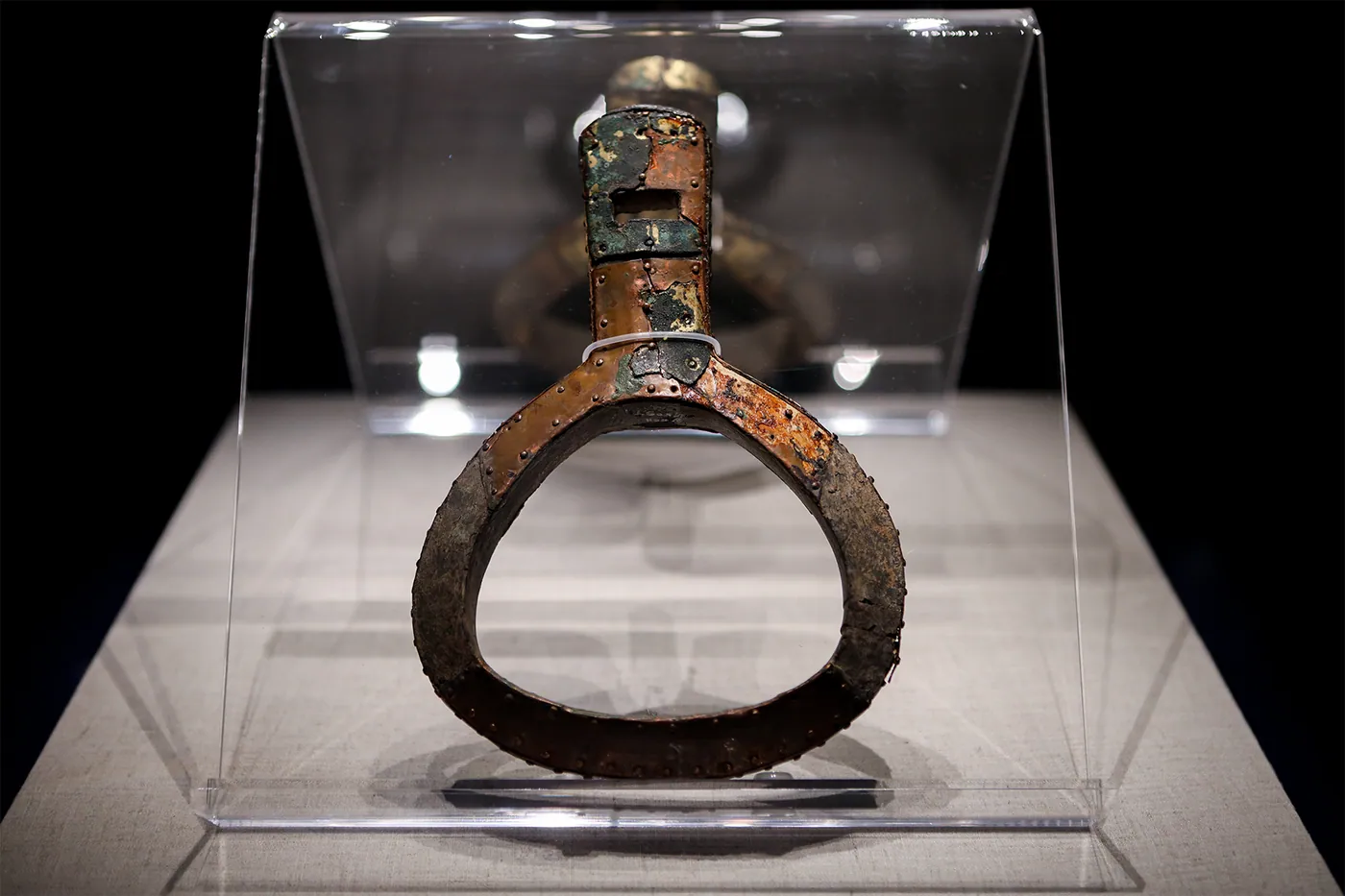
A ring hung either side of the saddle for the rider's foot. A single mounting-loop is discussed in early Indian and Chinese images; the earliest certain pairs of metal stirrups come from fourth- and early fifth-century tombs of the Xianbei states and Koguryŏ in northeastern China, after which they travelled west across the Eurasian steppe, reaching Byzantium and the Frankish world between the sixth and eighth centuries. The stirrup gives a rider a fixed purchase, letting him absorb the reaction at the instant of a shock delivered at speed. On this basis Lynn White Jr. proposed that the stirrup produced feudalism—a thesis since severely criticized and generally rejected, and still the standard case for asking how far technological determinism can be taken.
The saddle should have two iron stirrups.
—— Strategikon, attributed to the Emperor Maurice (c. 600), on equipment
History
The stirrup's function is to give the rider a fixed purchase. Riding without one did not rule out fighting (Scythians, Parthians, and Xiongnu were all famed horse-archers), but the rider must hold by his legs and by the saddle, and can hardly absorb the reaction at the instant a couched lance strikes at speed. A single mounting-loop is discussed in early Indian and Chinese images; for paired metal stirrups, the earliest certain finds are from fourth- and early fifth-century tombs in northeastern China, gilt bronze over a wooden core, among the remains of the Xianbei states and Koguryŏ, the pair from the tomb of Feng Sufu at Beipiao in Liaoning (c. 415) being especially securely dated. From there stirrups moved west with steppe horsemen: the Avars brought them into Pannonia in the sixth century, and the Byzantine Strategikon of about 600 already lists two iron stirrups as issue equipment for cavalry. Frankish finds date to the eighth century, roughly the age of Charles Martel. In China the stirrup was standard by the Tang, its form evolving from a plain ring to a broad flat tread.
The stirrup is one of a set of machines that Joseph Needham held to have passed from East Asia into Europe with marked consequences there; in his account it stands with the breast-strap and collar harness, the wheelbarrow, and water-powered blowing engines on a list of things the West received without knowing it. The list must be discounted today: Needham's model of transmission runs largely in one direction, whereas recent scholarship favours multiple points of origin across Eurasia and a traffic of mutual borrowing whose links often cannot be documented. For the stirrup, however, the East Asian origin and the general westward movement across the steppe still stand. One further observation of Needham's matters particularly here: stirrups were in general use in China for centuries, standard cavalry issue under the Tang, and never produced there anything resembling a system of enfeoffed knights. This is not an ethnographic comparison but a strict counter-instance: it sets one object beside two different social outcomes, and so voids on the spot any claim that the object must produce the institution. Bachrach's dismantling of White's thesis and those that followed took much of their external purchase from it.
Connections
Causes2
- IronworkingenablesMetal forging was the craft precondition of paired metal stirrups
- The Domestication of the HorseenablesRiding is the precondition of the stirrup
Sources
- Lynn White Jr., Medieval Technology and Social Change
- Bernard S. Bachrach, Charles Martel, Mounted Shock Combat, the Stirrup, and Feudalism
- Alex Roland, Technology and Culture 44 (2003), Once More into the Stirrups: Lynn White jr., Medieval Technology and Social Change
- 李约瑟(Joseph Needham)等, 《中国科学技术史》第四卷第二分册·机械工程
- Stirrup
Open questionspartly uncertain
- The origin and route of diffusion of the stirrup are unsettled: early evidence of single mounting stirrups is discussed for both India and China; the earliest securely attested paired metal stirrups come from fourth- and early fifth-century tombs in north-east China (such as the Yuantaizi tomb at Chaoyang and the tomb of Feng Sufu at Beipiao); and the timing and route of their westward spread remain disputed.
- Lynn White's causal chain "stirrup → heavy shock cavalry → grants of fiefs → feudalism" has been generally rejected by historians: Bachrach and others point out that Carolingian cavalry still often fought on foot, that the fief system arose before or independently of the stirrup, and that Frankish heavy cavalry took shape centuries after the stirrup arrived.
- No claim is made that the stirrup "caused" any social institution, and only its effects on warfare and riding are recorded; White's thesis is discussed separately as a case of historiographical controversy.
- "The stirrup made the medieval knight possible" is a popular claim that lacks support in the sources and is not adopted.
- Needham's framework of "Chinese mechanical inventions spreading west" is followed only for the East Asian origin of the stirrup and its westward route; its assumption of one-way diffusion and its overall picture of a long "Chinese lead" have been substantially revised in recent decades (independent invention at several points across Eurasia, multidirectional chains of transmission that often lack direct documentary evidence), so it is not treated as a general rule.
Why it matters
In 1962 Lynn White Jr. proposed, in Medieval Technology and Social Change, a handsome chain of causes: the stirrup made mounted shock combat possible; heavy cavalry was expensive; maintaining it required land; granting land produced feudalism—one iron ring accounting for a thousand years of European social structure. The fate of that thesis is worth remembering by anyone who writes about technology. Bernard Bachrach and others took it apart nearly link by link: Carolingian cavalry often dismounted to fight; mature shock tactics postdate the stirrup's arrival by centuries; benefice and dependence had legal and social sources of their own before it; and feudalism did not sprout wherever stirrups went: China had stirrups and no enfeoffed knights. The discipline's settlement is clear: reject the conclusion, keep the question. The question is how much a single object can change. The answer is not "nothing" (the stirrup did change what a person can do on horseback), but between what can be done and what a society becomes lie landholding, law, revenue, the form of war, and a great many particular human choices, none of which an iron ring decides for them. White's largest bequest to the field is that his error was clear enough to become the measure of every technological determinism after it.