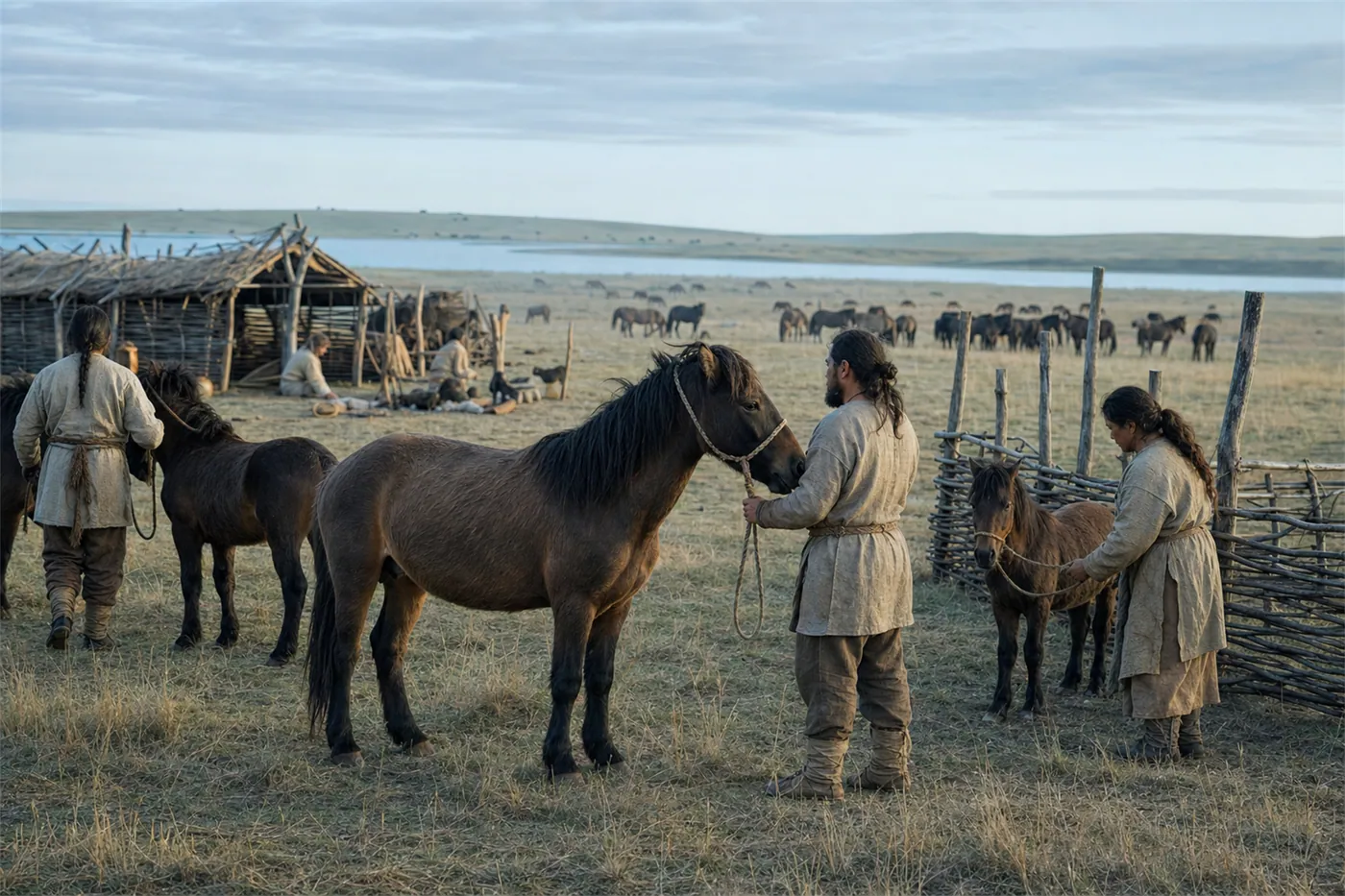
The conversion of wild horses to keeping, riding, and draught. The site of Botai in northern Kazakhstan (c. 3500 BCE) was long taken for the earliest evidence (bit wear on teeth, an overwhelming proportion of horse bone in the settlement, and residues of mare's milk fat in potsherds), but ancient-genome work in 2018 showed the Botai horses to belong to the Przewalski lineage and not to be ancestral to the modern domestic horse. Large-scale palaeogenomic analysis in 2021 placed the modern domestic lineage (DOM2) in the Black Sea–Caspian steppe, expanding rapidly from about 2200 BCE and displacing the other horse populations of Eurasia within a few centuries. What separates the horse from every earlier pack animal is speed and radius: it multiplied several times over the ground a person could cover in a day, and with it changed not only war but the form of steppe society, the routes of trade, and the distribution of languages.
They are so unused to walking, being always on horseback, that they can scarcely stand upon the ground; a whole people on horses.
—— Ammianus Marcellinus, Res Gestae, on the Huns (c. 390 CE)
History
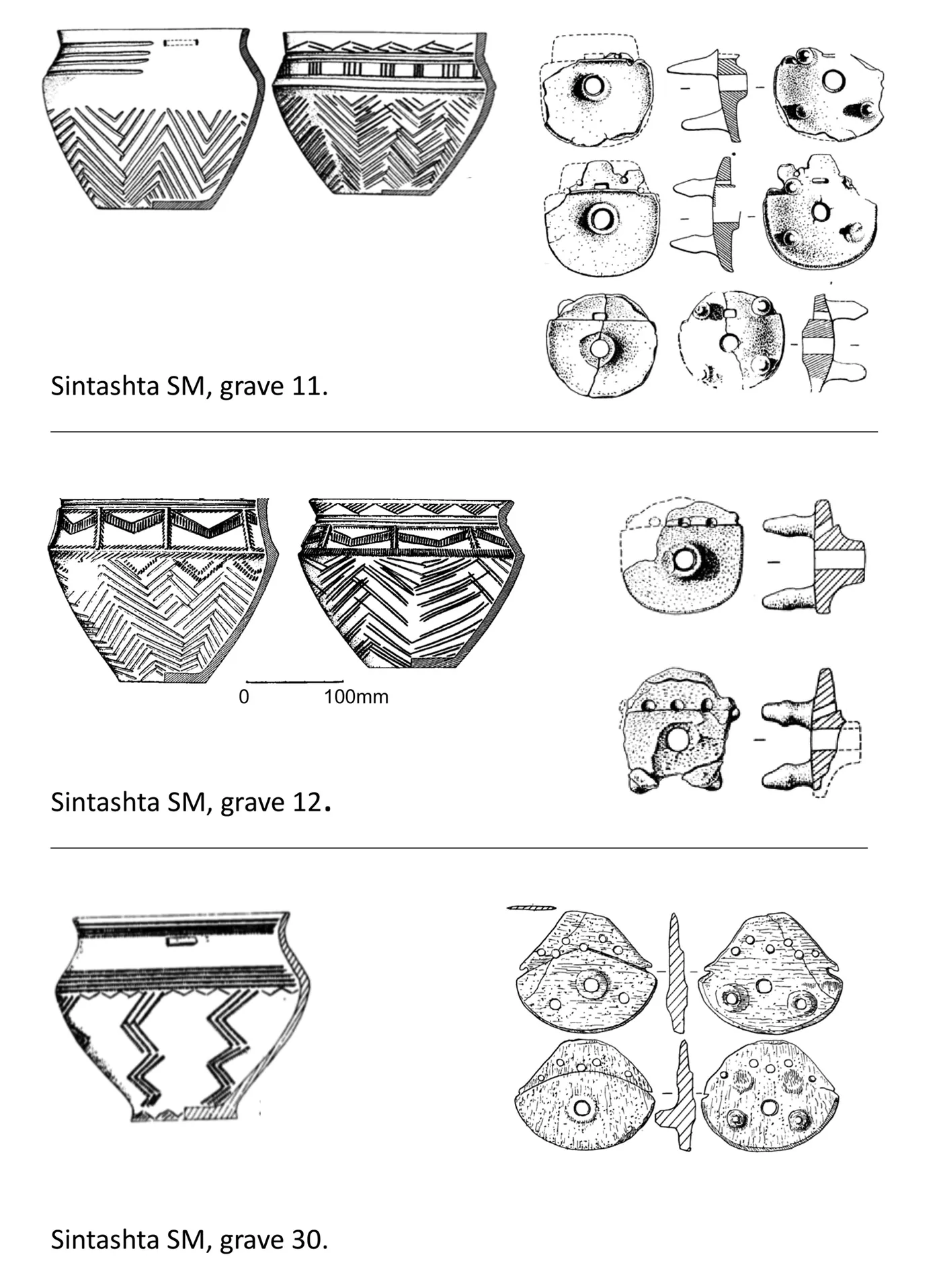
The domestication of the horse was long dated from the Botai culture of northern Kazakhstan. At that site (c. 3500 BCE) horse bone makes up more than nine-tenths of the fauna, some premolars show wear plausibly caused by a bit, and lipid analysis of potsherds detects mare's milk. Together these three lines put Botai into the textbooks as the earliest domestication. In 2018 Charleen Gaunitz and colleagues sequenced ancient genomes from Botai horses with an unexpected result: they belong to the Przewalski lineage, which had until then been taken for the one truly wild horse never domesticated. The Botai people were indeed managing herds, milking mares, and perhaps riding, but those horses are not ancestral to ours. Theirs was a separate domestication that later lapsed. In 2021 Pablo Librado, Ludovic Orlando and their collaborators sequenced more than two hundred ancient horse genomes across Eurasia and placed the modern lineage, DOM2, in the Volga–Don region of the Black Sea–Caspian steppe, expanding from about 2200 BCE and replacing the region's other horse populations within a few centuries—an expansion closely coincident in time with the spread of the spoked-wheel chariot and with the divergence of several Indo-European branches. The horse's uses then divided in two, driving and riding. The spoked-wheel chariots of the Sintashta culture (c. 2000 BCE) are the earliest secure evidence of driving; riding as an organized military arm took form on the steppe only in the first millennium BCE, with the composite bow and the tactics of mounted archery. For the two thousand years that followed, the relation between the farming civilizations of Eurasia and its mounted peoples was one of the continent's principal axes.
Connections
Consequences1
- The StirrupenablesRiding is the precondition of the stirrup
Sources
- David W. Anthony, The Horse, the Wheel, and Language: How Bronze-Age Riders from the Eurasian Steppes Shaped the Modern World
- Pablo Librado, Ludovic Orlando et al., Nature 598 (2021), The origins and spread of domestic horses from the Western Eurasian steppes
- Charleen Gaunitz et al., Science 360 (2018), Ancient genomes revisit the ancestry of domestic and Przewalski's horses
- Domestication of the horse
Open questionspartly uncertain
- Two ancient-genome studies, in 2018 and 2021, substantially revised the earlier core conclusion: Botai is no longer seen as the origin of modern domestic horses, and earlier literature (including some claims in Anthony 2007) must be reread accordingly.
- Using "bit wear" as evidence of riding is itself a contested criterion, since tooth wear can have other causes.
- The date of about 2200 BCE for the expansion of the DOM2 lineage is a median genomic estimate with a wide confidence interval.
- Whether riding or driving came first is unresolved; securely attested chariots (Sintashta, c. 2000 BCE) predate securely attested cavalry units by about a thousand years, but this does not necessarily mean that everyday riding appeared later.
Why it matters
The manner in which the subject was rewritten within a decade deserves attention in its own right. The Botai account was not overturned by a newly found site, nor by a better argument, but by a new technique of reading. As ancient-DNA sequencing matured through the 2010s, many long-standing archaeological disputes turned from which interpretation is more reasonable into what the genomes say—and the genomes have often answered as no party expected. Two consequences follow, both worth the historian of technology's notice. The first is method dependence: the questions a discipline can ask are bounded by the traces it can read, and when the legibility of traces changes, the list of questions is reordered. This is the other face of what the history of the germ theory shows, that what a discipline accepts as evidence has a history of its own. The second is the necessity of modesty. The Botai account had three independent lines of support and stood in textbooks for decades, and it was wrong, not through careless inference but as the best inference then available. Between a settled conclusion in a textbook and the best answer known, there is always the next technique of reading. As for the horse, its historical weight is usually compressed into military advantage, when the deeper layer is radius. A day's reach extended from twenty or thirty kilometres to a hundred and more, which meant herds could rotate among distant pastures, news could cross hundreds of kilometres in days, and a force could appear where no road ran. Pastoral nomadism as a way of life, and not merely as an economy, exists only after the horse.