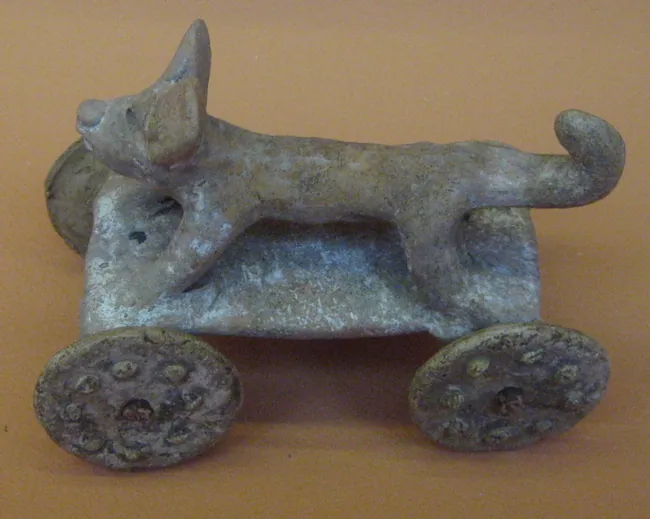
A disc turning about a fixed axis to carry or to form. The earliest known wheels served the potter (Mesopotamia, c. 4000 BCE); wheels for transport appear about 3500 BCE, and the evidence is close in date across three places—a four-wheeled wagon incised on a pot at Bronocice in Poland, wagon signs on tablets at Uruk, and a complete wooden wheel from the Ljubljana Marshes in Slovenia (c. 3200 BCE). Whether the origin lies in Mesopotamia or on the steppe north of the Black Sea is unsettled. The real threshold is not the disc but the axle: matching a round hub to a straight shaft demanded a tolerance beyond earlier carpentry. Mesoamerican cultures made small ceramic figures with wheels and axles and never put the wheel to transport.
Hebe in speed set about the chariot the curved wheels, eight-spoked and brazen, with an axle of iron both ways.
—— Homer, Iliad V (trans. Richmond Lattimore)
History
The earliest wheels did not travel: by about 4000 BCE Mesopotamian potters were shaping vessels on a turning disc. Wheels for transport appear about 3500 BCE, and the evidence surfaces in three places almost at once—a four-wheeled wagon incised on a pot at Bronocice in Poland, wagon signs on tablets at Uruk, and a complete wooden wheel from the Ljubljana Marshes in Slovenia (c. 3200 BCE). Which came first is still undecided. The real threshold was the axle: hub and shaft must both be true, and the shaft thin enough to reduce friction yet thick enough to bear load, a tolerance beyond earlier carpentry. Around 2000 BCE the spoked wheel appeared in western Asia; vehicle weight fell sharply and the chariot became the decisive arm of the late Bronze Age. For millennia after, the wheel changed little, until the modern age set it on an iron rail, where a flange replaced the driver, and direction was given no longer by a hand but by the track. Mesoamerica forms a case of its own: small ceramic figures with wheels and axles, of the first centuries CE, have been excavated on the Gulf Coast (around present-day Veracruz) and elsewhere, so the principle was known. But there were no large draught animals to harness, the terrain was mountain and forest, and the existing system of human porterage and canoes worked. The wheeled vehicle did not follow.
Connections
Consequences1
- The RailwayenablesThe wheel is a distant ancestor of the railway; the flanged wheel held by a guiding rail is its immediate form
Sources
- David W. Anthony, The Horse, the Wheel, and Language
- Stuart Piggott, The Earliest Wheeled Transport: From the Atlantic Coast to the Caspian Sea
- 荷马, 《伊利亚特》第五卷
- Wheel
Open questionspartly uncertain
- The place of origin is unresolved: the Mesopotamian hypothesis and the hypothesis of the steppe north of the Black Sea each have supporting evidence, and the earliest finds and images, from central Europe, eastern Europe and the Near East, are close in date (around 3500 BCE), so no single origin should be asserted.
- Which came first, the potter's wheel or the vehicle wheel, is also disputed; the two require different precision in their bearings.
- The explanation for Mesoamerica having wheeled toys but no wheeled vehicles (no large draught animals to harness, broken terrain, and effective existing systems of human porterage and canoes) is an inference from several combined causes, not a settled conclusion.
- Rankings such as "the wheel is the greatest invention" are best avoided.
Why it matters
The wheeled figurines of Mesoamerica are one of the best lessons in the history of technology. Read teleologically they are a near miss: they reached the door and did not go through. Set out the conditions and not going through is the reasonable outcome—no cattle or horses to harness, a cost of cutting road through mountain and rainforest higher than carrying, one canoe worth dozens of porters. Wheeled transport spread in the Old World not because the wheel beats the foot but because that world happened to hold, together, domesticable draught animals, passable plains, and freight enough to matter. A technology is not adopted for being more advanced; it is adopted for paying better where it stands. Conversely, Mesoamericans fitting wheels to small ceramic dogs and the Inca building more than thirty thousand kilometres of road with no wheel at all are not evidence of failure but sound answers under different constraints. We call such cases "non-adoption," and inside that "non" there is still a ladder of progress we have not quite given up.