The technique of smelting copper with tin (and, earlier, arsenic) into an alloy. Arising around 3300 BCE in Southwest Asia and Anatolia, it spread across Eurasia. Bronze is harder than copper, melts lower, and casts well, allowing standardized production of weapons, ritual vessels, tools, and weights. Because tin is geologically scarce and scattered, the Bronze Age depended on long-distance trade—its fatal weakness: when the eastern Mediterranean system collapsed around 1200 BCE and the tin routes failed, iron rose in its place.
There are six alloys of metal: with the metal in six parts and tin one, this is the alloy for bells and cauldrons.
—— Kaogongji, in the Rites of Zhou (c. Warring States)
History
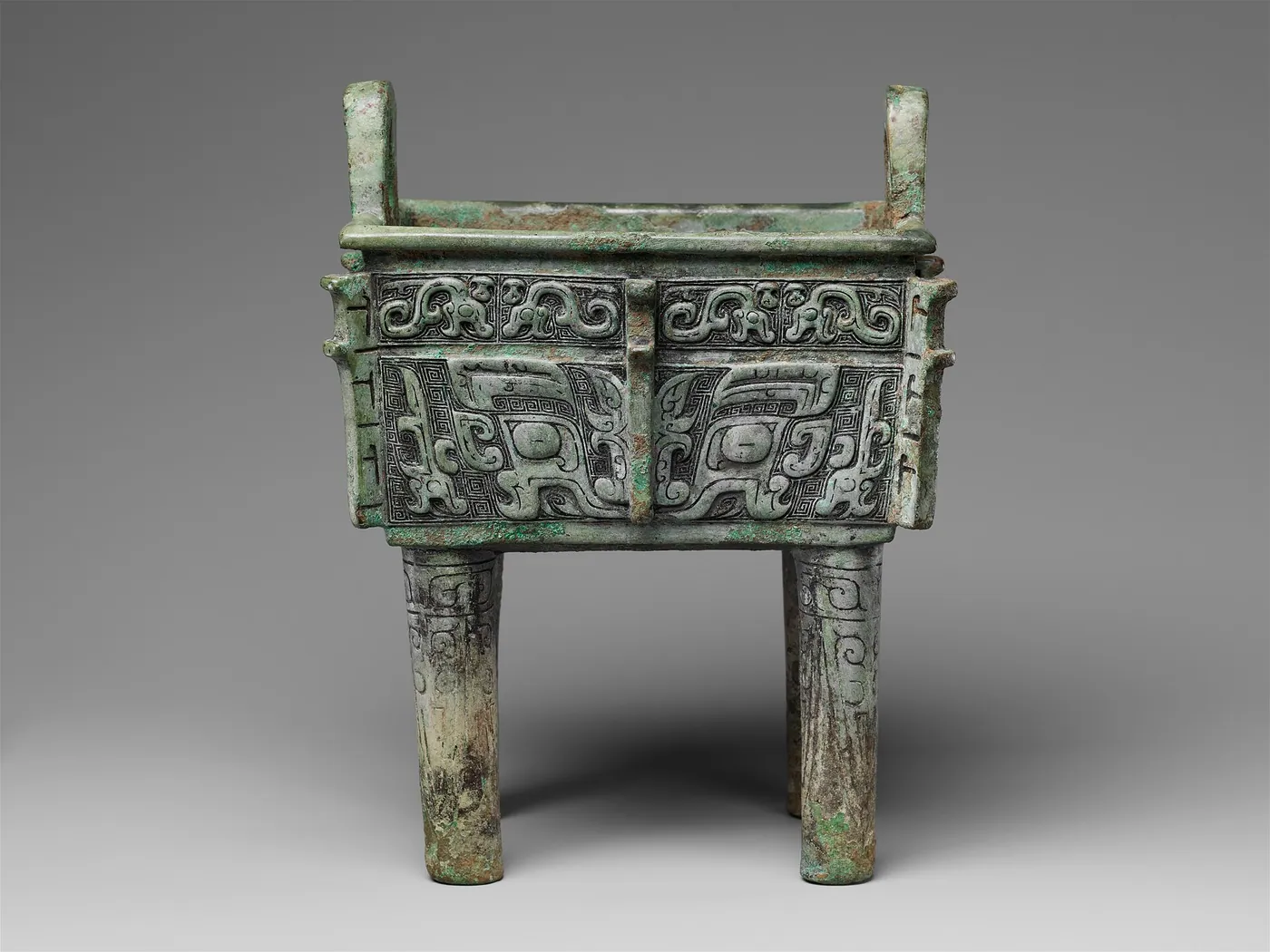
Copper occurs in native form, and early humans worked it cold. In the fourth millennium BCE smiths in Southwest Asia and Anatolia began smelting copper ores and found that adding arsenic hardened the product; this was arsenical copper, and some scholars think the smelters paid for it with chronic arsenic poisoning. From about 3000 BCE tin gradually displaced arsenic: tin bronze is harder, melts below pure copper, and flows well, suiting complex castings. Over the following two millennia bronze technology unfolded across Eurasia: tools and weapons in Mesopotamia and Egypt, ritual and trade goods in the Aegean, and in China the ritual vessels of Erlitou through Shang and Zhou, whose piece-mould casting of taotie-decorated tetrapods followed a path quite distinct from West Asian lost-wax. Tin's scarcity shaped the geography of the age: ore from Cornwall, Afghanistan, and Central Asia traveled thousands of kilometres to the civilizational centres. Around 1200 BCE the states of the eastern Mediterranean fell one after another, the networks tore, copper and tin grew hard to obtain—and iron ore, which lies almost everywhere, took over.
Connections
Causes1
- CastingenablesMuch of bronze's value lay in being castable: alloying lowered the melting point and improved flow, and moulding made complex forms and repeatable copies possible
Echoes1
- IronworkingechoesNot a linear upgrade: iron spread because tin routes failed and iron ore is ubiquitous
Sources
- Barbara S. Ottaway, The Bronze Age: Metallurgy and Society
- 张光直, 《中国青铜时代》
- Bronze Age
Open questionswell attested
- Arsenical bronze preceded tin bronze as a result of using locally available materials; the sequence should not be read as an "evolution".
- Bronze metallurgy arose in several centres (West Asia, the Balkans, China and elsewhere), and the relative weight of diffusion and independent invention is still disputed.
- Scholars have not agreed on the causes of the Bronze Age collapse around 1200 BCE (climate, the Sea Peoples, systemic fragility).
Why it matters
Bronze is an early lesson in supply chains. Its advantage lay not only in material properties but in the organization it forced into being: prospecting, mining, smelting, long-haul transport, royal storehouses, hereditary craft. For the same reason it could not save itself when the system fell—a technology dependent on distance holds its fate somewhere it cannot reach. The Chinese branch is worth noting on its own terms: bronze there went overwhelmingly into ritual vessels rather than farm tools, and casting a cauldron was an act of political definition. The same material answers different questions in different societies; to measure advancement by the presence of bronze ploughshares is to bring one set of questions to another set of answers.