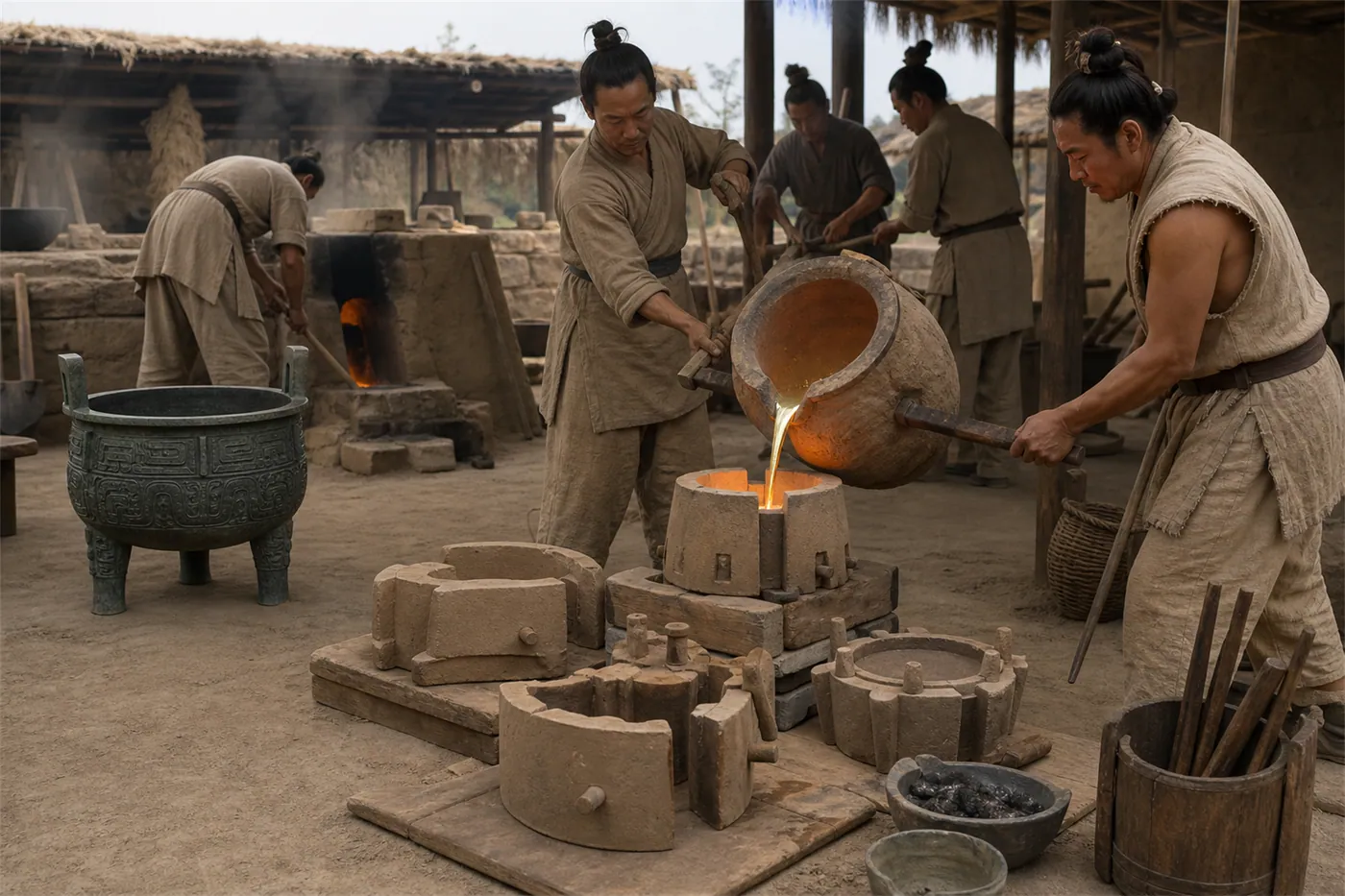
The shaping of metal by melting it, pouring it into a mould, and letting it solidify. It arose with the smelting of copper in the fourth millennium BCE and for the first time freed the shape of a metal object from what a hammer could reach: hollow, branching, ornamented forms could now be made in one operation, and repeated from the same mould. Lost-wax casting appears in the Near East and the Indus around the end of the fourth millennium; Shang China carried the piece-mould method to its limit, assembling dozens of ceramic sections to pour bronze cauldrons of more than eight hundred kilograms. Casting was also the key to China's separate iron road: shaft furnaces ran hot enough to tap liquid cast iron and pour farm tools directly, some eighteen centuries before the European blast furnace. The price is brittleness—coarse grain and internal porosity make castings crack along grain boundaries under shock, so load-bearing pieces must still be forged.
Of the casting of cauldrons before the age of Yao and Shun nothing can be known. Yu alone cast the Nine Cauldrons—for by then the tribute of the Nine Provinces was assessed, the yearly offerings fixed, and the rivers dredged and open; that these things might endure, he cast them.
—— Song Yingxing, Tiangong Kaiwu, on founding (1637)
History
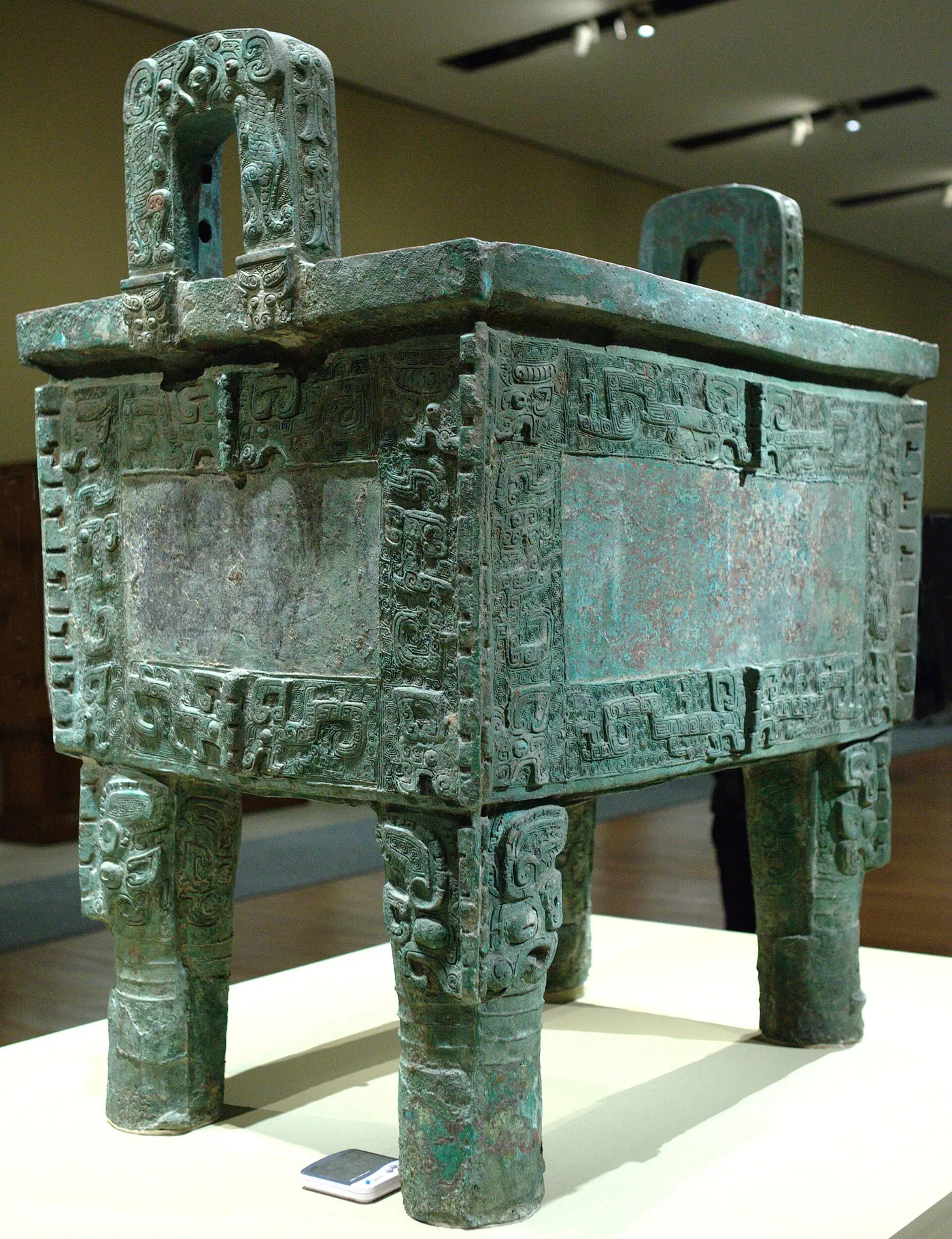
Casting presupposes smelting, and so begins some four thousand years after forging. The earliest known metal moulds appear in the fourth-millennium Near East: molten copper poured into open stone hollows to make flat axes and chisels, then bivalve moulds closed on each other to shape both faces. What truly freed shape was the lost-wax process—model the object in beeswax, coat it in clay, fire the shell until the wax runs out, and pour bronze into the void: the freedom of the wax is the freedom of the object. The method was in use in the Near East and South Asia by the fourth millennium BCE; the "dancing girl" bronze from Mohenjo-daro (c. 2300–1750 BCE) is the best-known Indus example. China took another road. Shang founders did not work chiefly in lost wax but pushed the piece-mould method to a degree that still astonishes: dozens of ceramic sections, their ornament carved in the negative, assembled inside and out and poured at once to yield a vessel covered in taotie masks. The Houmuwu cauldron from Anyang weighs more than eight hundred kilograms and required several furnaces tapping together. That founding tradition took up iron directly: by the fifth century BCE at the latest, Chinese shaft furnaces reached above the melting point of cast iron, and liquid iron could be poured into moulds as bronze was, so that cast-iron farm tools became common in the Warring States. Europe had no workable blast furnace until the fourteenth century, and only after coke replaced charcoal in the eighteenth did cast iron become the stuff of bridges, machine tools, and steam-engine cylinders.
Connections
Causes2
- Control of FireenablesThe heat needed to melt and pour copper came from long mastery of fire
- PotteryenablesKiln heat, clay moulds and crucibles prepared the way for casting; Shang bronzes were cast in ceramic piece-moulds
Consequences3
- Bronze MetallurgyenablesMuch of bronze's value lay in being castable: alloying lowered the melting point and improved flow, and moulding made complex forms and repeatable copies possible
- IronworkingenablesChinese shaft furnaces ran hot enough to tap and pour liquid iron, a road parallel to the West Asian and European bloomery-and-forge route
- Wootz SteelenablesWootz was won as a cake from a crucible melt, a liquid-state route; the blade that followed was made by forging
Sources
- 李约瑟(Joseph Needham)等, 《中国科学技术史》第五卷第十一分册·钢铁冶金
- Theodore A. Wertime & James D. Muhly (eds.), The Coming of the Age of Iron
- Robert W. Bagley, Ancient Chinese Bronzes: Casting Technology and Style
- Casting
Open questionswell attested
- The earliest examples of lost-wax casting (in the Near East, the Indus region and the Balkans) are close in date and each has its advocates, so which came first is unresolved.
- Whether piece-mould or lost-wax casting predominated in the Shang has long been debated; the mainstream view is that piece-mould casting was the main technique of the Shang and Zhou, and securely attested examples of lost-wax casting in China are later.
- The statement that China mastered iron casting about 1,800 years before Europe refers only to the gap in securely dated archaeological evidence for casting iron directly from shaft furnaces and does not imply an overall lead in metallurgy.
- That castings are mechanically inferior to forgings is a finding of modern metallurgy; ancient craftsmen divided work between forging and casting by experience and did not explain it by this mechanism.
Why it matters
What casting best exposes is the emptiness of the phrase "level of technology." Measured by who first shaped metal in the liquid state, China led Europe in iron by some eighteen centuries; measured by fineness, the ornament pulled from Shang piece-moulds was unmatched until mechanical reproduction. Neither ruler measures what actually followed: cast iron became an industrial material in Europe and remained, in China, largely a matter of hoes and cooking pots. The difference is not in knowing how to cast but in what economy the castings fell into: eighteenth-century Britain had coal, coke, a standing demand for standardized parts, and shareholders willing to pay for an iron bridge. What is most often mistaken in the history of technology for "ahead and behind" is in fact use and market. A second layer is the honesty of the division of labour. Castings are handsome, reproducible, and cheap—and brittle; every part that takes a blow, edge, ploughshare, axle, has always been forged or surface-treated instead, in every tradition. Chinese puddling and co-fusion, European malleable iron and annealing, are different answers to a single question: how to put the freedom of casting and the toughness of forging into the same object.