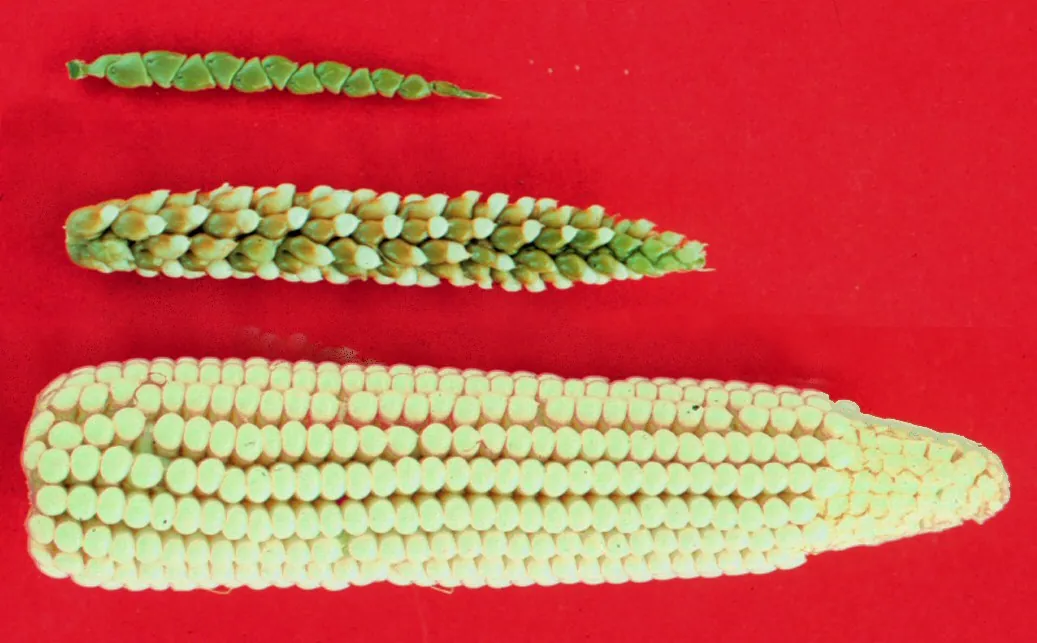
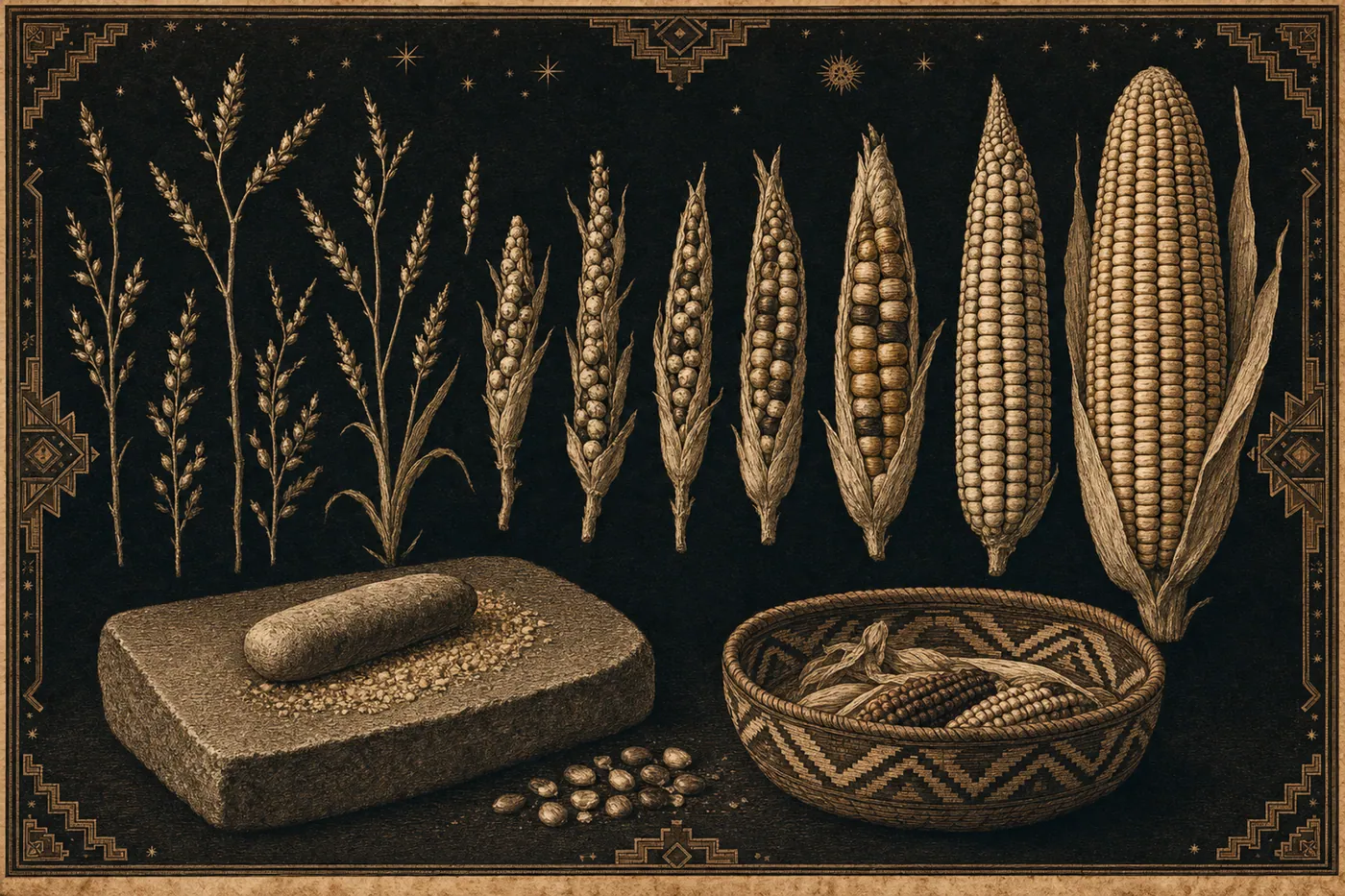
The long selection of maize from wild teosinte in Mesoamerica. A teosinte ear bears only five to twelve hard-cased kernels and looks nothing like a modern cob; molecular and archaeological evidence point to domestication in the Balsas valley of southwestern Mexico from about 7000 BCE, with maize a staple in Mesoamerica by about 2000 BCE. As important as the breeding is a chemical process—nixtamalization: boiling and steeping the grain in lime or wood-ash water, which frees the niacin maize holds in a bound form the human gut cannot take up, and improves the protein. When maize crossed to the Old World in the sixteenth century the process did not travel with it, and the consequence was two centuries of pellagra in southern Europe, the Balkans, and the American South.
Of yellow maize and of white maize their flesh was made.
—— Popol Vuh (K'iche' Maya; written down in the mid-16th century, surviving in Francisco Ximénez's copy of c. 1701)
History
Maize's wild ancestor is teosinte, a Mexican grass whose ear carries five to twelve hard-cased kernels. Multilocus microsatellite analysis in 2002 placed domestication in a teosinte subspecies of the Balsas valley in southwestern Mexico, where cave sites have yielded maize starch grains and phytoliths of about 7000 BCE. Over the following millennia the cob ceased to shatter, the glumes reduced, and kernel number and size increased greatly—a morphological change so large that nineteenth-century botanists doubted the two plants were related. By about 2000 BCE maize was a staple in Mesoamerica, spreading north to the Puebloan southwest and south to the fringes of the Andes. Alongside the breeding went a chemical process: soaking and boiling the grain in lime or wood-ash water loosens the pericarp and makes the dough cohere, while freeing the niacin that maize holds in a bound form the human gut cannot take up. After 1492 maize crossed rapidly to the Old World: drought-tolerant, high-yielding, widely adaptable, it became the food of the poor in northern Italy, the Balkans, Africa, and the uplands of China. Nixtamalization did not cross with it. From the eighteenth century pellagra spread through Asturias, Lombardy, and Romania; in the American South between 1902 and the 1940s it killed more than a hundred thousand people; it was Joseph Goldberger who showed it to be a deficiency of diet and not an infection.
Connections
Consequences1
- The Columbian ExchangeenablesDomesticated maize became one of the most consequential American crops of the Columbian exchange
Sources
- Matsuoka et al., PNAS (2002), A single domestication for maize shown by multilocus microsatellite genotyping
- Katz, Hediger & Valleroy, Science 184 (1974), Traditional Maize Processing Techniques in the New World
- 《波波尔·乌》(基切玛雅创世书)
- Maize
Open questionswell attested
- The date of the start of domestication has been revised in the light of new starch-grain and phytolith evidence from the Balsas valley, with proposals ranging from about 9000 to 7000 BCE.
- A single origin (supported by the molecular evidence of Matsuoka et al., 2002) is the mainstream view, but repeated backcrossing with wild relatives during early dispersal complicates the picture.
- The nutritional mechanism of nixtamalization was proposed by Katz et al. in 1974 and is widely accepted, but the motives for adopting it in different places (nutrition, taste, ease of removing the hulls) are hard to establish from the sources, and it should not be inferred backwards that early peoples knew of its nutritional value.
- The link between pellagra and "the crop travelled but the process did not" is the consensus view, but pellagra in Europe was also shaped by poverty and monotonous diets and had more than one cause.
Why it matters
Maize is often told as a success of exchange: an American crop that fed Old World population growth. True, and half the story. A crop can be shipped; a process cannot. Nixtamalization had been practised in Mesoamerica for three thousand years as knowledge embedded in daily life (how long to soak, which ash, what the dough should feel like), never written as a recipe, and with no reason to be, because where it was practised it never needed explaining. Those who crossed the ocean carried off the visible half: seed, yield, drought tolerance. Only in the twentieth century did the laboratory rediscover why the process mattered. Failures of technology transfer are usually not about the difficult part going unlearned, but about the part too simple to mention going uncarried. The point has not dated: in any importation of "advanced technology," what is most often lost is the operational common sense the locals thought not worth saying. A second layer concerns proportion in attribution: pellagra was not caused by a missing process alone—poverty and dietary monotony were conditions of equal weight. One process no more explains an epidemic than one seed explains a population.