Alfred Crosby's 1972 term for the large-scale two-way transfer of plants, animals, pathogens, and peoples between the hemispheres after 1492. Maize, potato, sweet potato, tomato, chili, and cassava went east, raising the carrying capacity of Eurasia and Africa; wheat, sugar, horses, cattle, and pigs went west, remaking American agriculture and landscape. The pathogens that traveled with them, such as smallpox and measles, produced among immunologically naive Native Americans one of the gravest demographic collapses in human history.
After 1492 humanity ceased to live in many worlds on one planet, and began to live in one.
—— Summarized from the thesis of Alfred W. Crosby, The Columbian Exchange (1972)
History
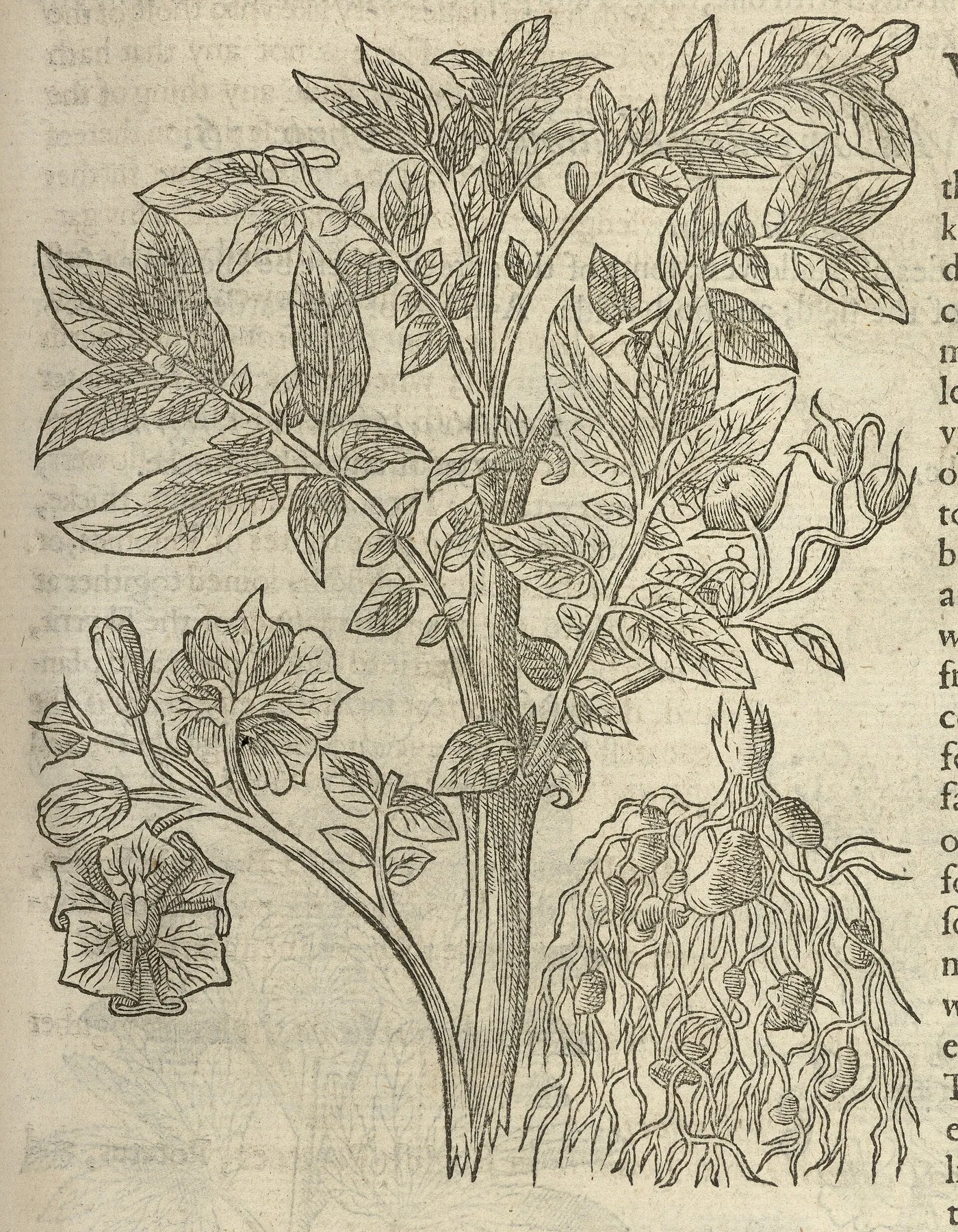
In the three centuries after 1492 two long-separated biotas were forcibly joined. Crops moving east from the Americas altered Old World diets and population curves: the potato suited the cold, wet soils of northern Europe and became a staple in Ireland, the German lands, and Russia; maize and sweet potato, tolerant of drought and poor soils, entered the uplands of China and much of Africa, and the demographic growth of the Ming and Qing is associated with them (with the weighting still disputed); tomato, chili, cacao, and tobacco rewrote the cuisines and habits of the Mediterranean, South Asia, and East Asia. Westward went wheat, rice, sugar, coffee, and Eurasian livestock—horses reached the North American plains and transformed Indigenous hunting and warfare within a century, while the hooves and teeth of cattle and sheep remade grasslands. The heaviest strand was pathogenic: smallpox, measles, typhus, and influenza swept year after year through populations with no prior exposure and, compounded by war, enslavement, forced relocation, and the collapse of subsistence systems, brought a drastic decline in Native American populations within a century and a half (pre-contact population estimates themselves diverge widely, so no precise proportion can be given). And there were people moved by force: the transatlantic slave trade ran on the same network, carrying West African populations and crops together into the Americas.
Connections
Causes1
- The Domestication of MaizeenablesDomesticated maize became one of the most consequential American crops of the Columbian exchange
Consequences1
- MonocultureenablesThe global transplantation of crops supplied the material precondition for large-scale monoculture
Sources
- Alfred W. Crosby, The Columbian Exchange: Biological and Cultural Consequences of 1492
- Charles C. Mann, 1493: Uncovering the New World Columbus Created
- Columbian exchange
Open questionswell attested
- Estimates of the scale and absolute size of the collapse of the Indigenous population of the Americas vary enormously (pre-contact estimates range from 40 million to 100 million), and the relative weight of disease and of violence, enslavement and the destruction of livelihoods is also debated.
- The "Columbian" and "pre-Columbian" theories of the origin of syphilis remain unresolved.
- The causal weight of American crops in China's population growth under the Ming and Qing is disputed (other explanations point to the tax and labour-service system, land reclamation and climate).
- The epigraph summarizes Crosby's main argument (it is not a verbatim quotation), as noted with the quotation.
Why it matters
The power of Crosby's concept is that it prised the history of conquest away from a purely political-military narrative and let biology in: the Spanish were few and prevailed, and while firearms and horses helped, what emptied the field before them was pathogens. This is not a defence of conquest, since beyond disease there were massacre, enslavement, and institutional dispossession; it is a demand that explanation be complete. It also forces an asymmetry into view: the exchange ran both ways, the benefits did not. The Old World gained calories and population; the New World gained emptied villages. To sum all this under the neutral word "exchange" carries a smoothness that deserves suspicion. A further layer concerns the length of causation: the Irish famine, the opening of Chinese uplands, the cassava fields of Africa, and the tomato sauce of Italy are aftershocks of one biological reorganization. The history of technology tends to focus on artefacts; the Columbian exchange is a reminder that moving a single plant has sometimes changed more lives than building a machine.