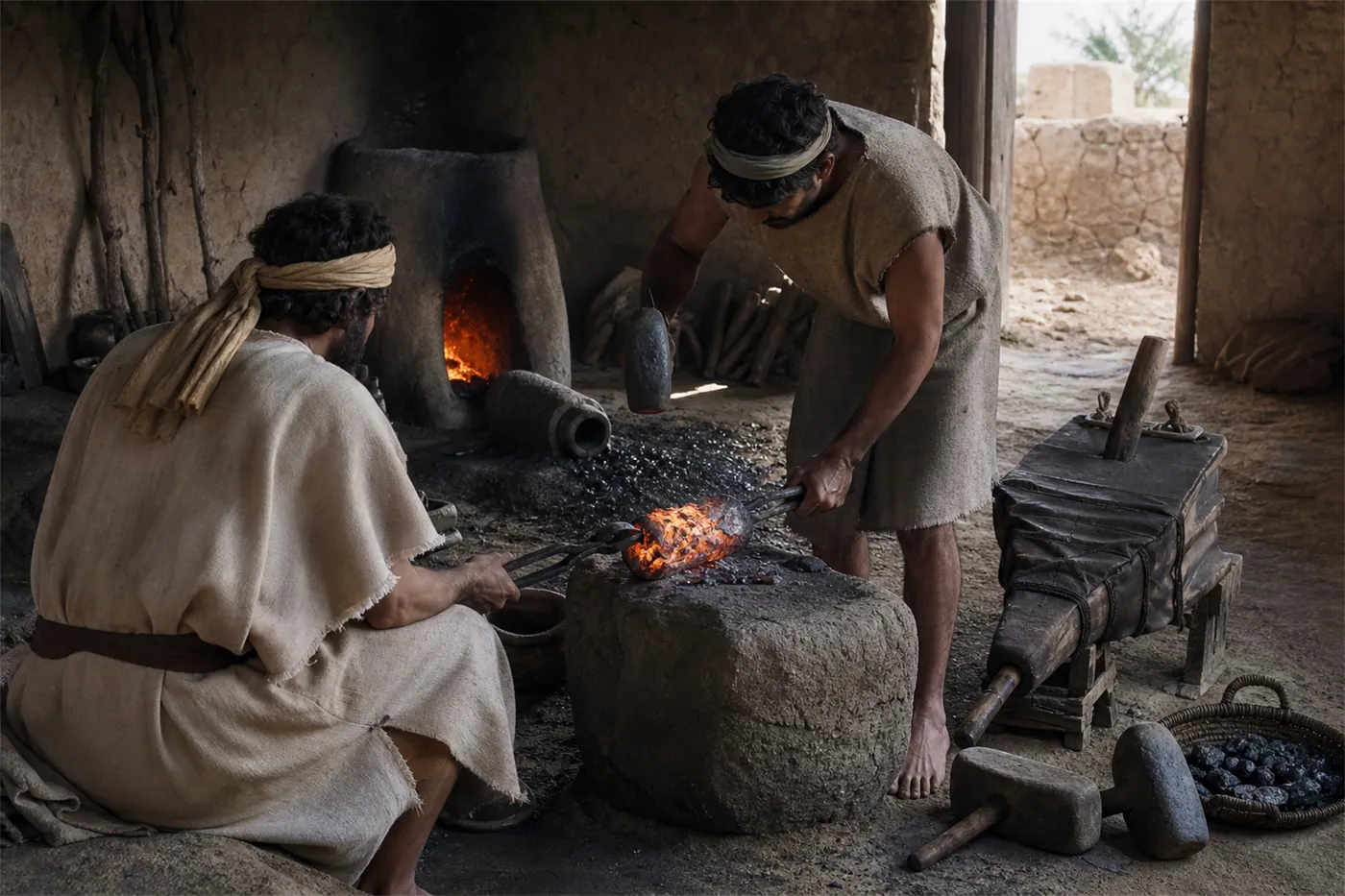
The shaping of metal in the solid state by hammering. It is the oldest form of metalworking: at sites such as Çayönü in Anatolia, small objects of native copper were cold-hammered in the eighth millennium BCE, before any smelting. Forging changes not only shape but substance—hammering breaks up the coarse as-cast grain and draws inclusions into flow lines along the direction of working, so that a forged piece is tougher and more shock-resistant than a casting of the same composition. The bloomery iron route of West Asia and Europe depended on it entirely: furnaces too cool to melt iron yielded a slag-riddled sponge that could be consolidated only by reheating and hammering the slag out. Folded blades, horseshoes and hoes, and the die-forged crankshafts of the industrial age are all extensions of the same operation.
So doth the smith, sitting by the anvil and considering the iron work; the vapour of the fire wasteth his flesh, and he fighteth with the heat of the furnace.
—— Sirach 38 (c. 2nd century BCE)
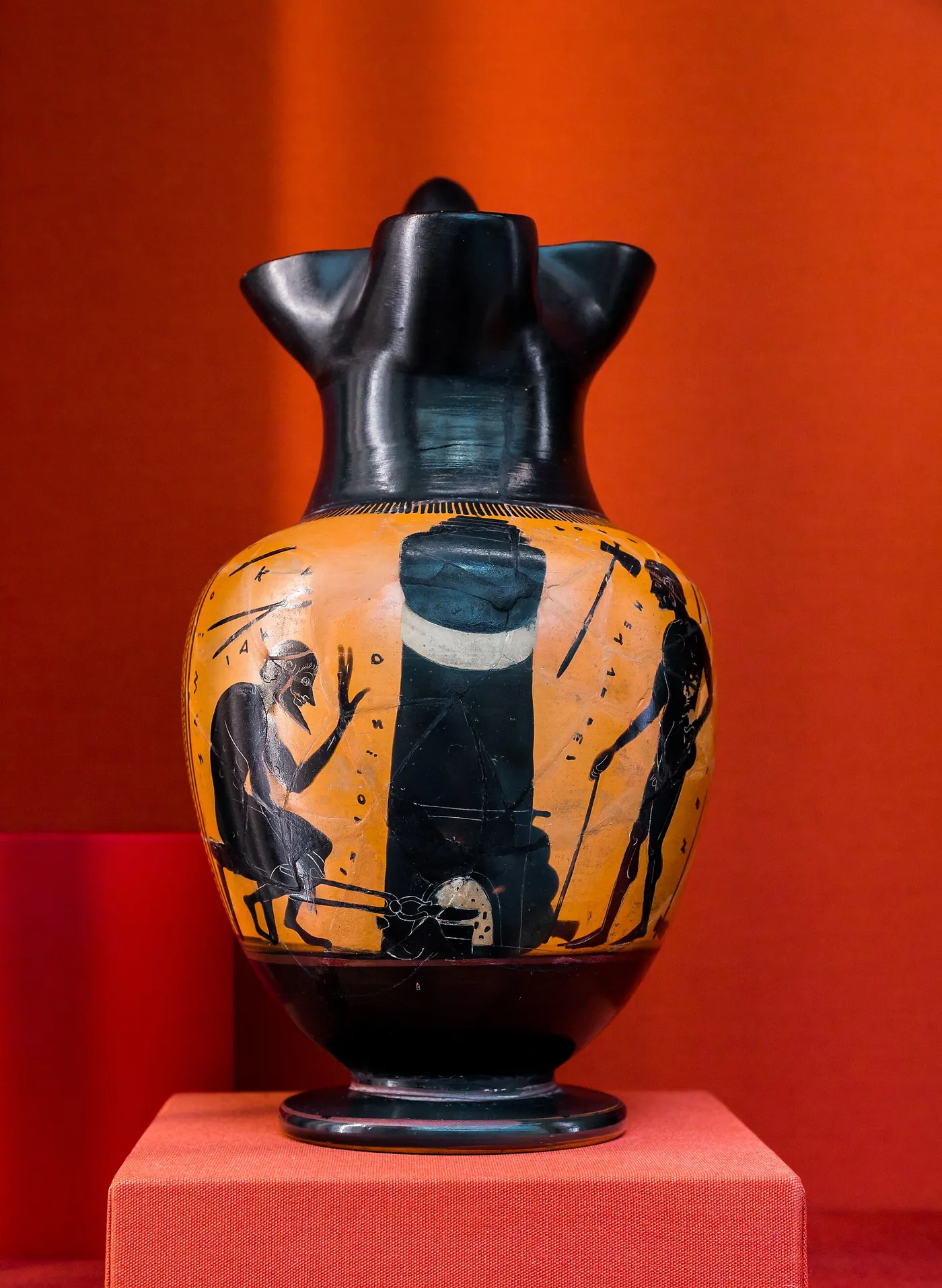
History
The earliest metal objects were not cast but hammered. At Çayönü in southeastern Anatolia, small objects of native copper (awls, pins, beads) were cold-hammered in the eighth millennium BCE, at a time when smelting was unknown and copper was simply an odd stone that could be beaten into shape without shattering. Cold work hardens copper and makes it brittle, so that continued hammering cracks it; annealing (heating and slow cooling) restores ductility, and with that discovery forging first became a controllable craft. Smelting and casting did not displace it but divided the work with it: cast what is complex, forge what must bear load. Iron raised forging's standing again. The bloomeries of West Asia and Europe ran at 1100–1300°C, short of iron's melting point, and yielded a spongy mass of metal and slag that had to be hammered hot, again and again, to squeeze the liquid slag out before usable wrought iron remained. A good sword therefore meant dozens, sometimes hundreds, of heats and hammerings. The medieval water-powered trip hammer handed that labour to rivers; die forging and the steam hammer of the nineteenth century handed it to machines—the same motion, scaled from a man's arm to a falling weight of several tons.
Connections
Causes1
- Stone ToolsenablesThe first metal forging was hammering native copper with stone hammers
Consequences2
- IronworkingenablesBloomery iron leaves the furnace as a slag-riddled sponge that only repeated hot hammering turns into wrought iron; forging was thus essential to the West Asian and European iron route
- Wootz SteelenablesThe crucible cake was forged into a blade by long, low-temperature working, in which the pattern also emerges
Sources
- Theodore A. Wertime & James D. Muhly (eds.), The Coming of the Age of Iron
- Aslıhan Yener et al., Çayönü Tepesi and the beginnings of metallurgy in the Ancient World
- Forging
- 宋应星(1637), 《天工开物·锤锻》
Open questionswell attested
- The earliest date for cold-forged native copper shifts with new excavations; finds from sites such as Çayönü and Çatalhöyük mostly date from the eighth to the seventh millennium BCE.
- That forging improves mechanical properties is established metallurgy, but how far ancient smiths understood the mechanism cannot be known, so only the effects of the process can be described, not their understanding of it.
- Popular works often exaggerate the link between the number of folds and blade quality ("a thousand hammerings" is mostly a figure of speech), and too much folding is actually harmful.
Why it matters
Forging is often filed in the history of technology as the primitive stage before casting, and the ordering is wrong in an instructive way. It misreads craft history as a single line of progress, as though each practice were waiting to be superseded by the next. In fact the two hold distinct and irreplaceable physical positions: castings have coarse grain and internal porosity and crack along grain boundaries under shock, while a forging's flow lines follow its shape, giving several times the toughness at the same composition. Which is why heavily loaded crankshafts, connecting rods, landing gear, and wrenches are still mostly forged. A technique is generally "superseded" only in a table of contents; on the shop floor each keeps its own share of the physics. A second layer concerns labour. Forging is the most labour-intensive of all metal processes—a charge of iron may take dozens of heats and hammerings, and most of its cost lies not in ore but in people. That is why water-powered and then steam hammers were developed first in Europe: not because anyone there was cleverer, but because smiths' wages there were the first to become dear enough to be worth replacing with a river.