Vessels shaped from clay and hardened in fire. The oldest known sherds, from Xianrendong Cave in Jiangxi, China, are about 20,000 years old, some ten thousand years older than farming in the region; pottery was invented independently many times.
In the time of Shennong, millet rained from the sky, and Shennong tilled the ground and sowed it. He made pottery, worked metal into axes and adzes, and fashioned ploughs, hoes and weeders to clear the wild grasses.
—— A lost passage of the Zhou shu, quoted in Jia Sixie, Qimin yaoshu, chapter 1 (6th century CE)
History
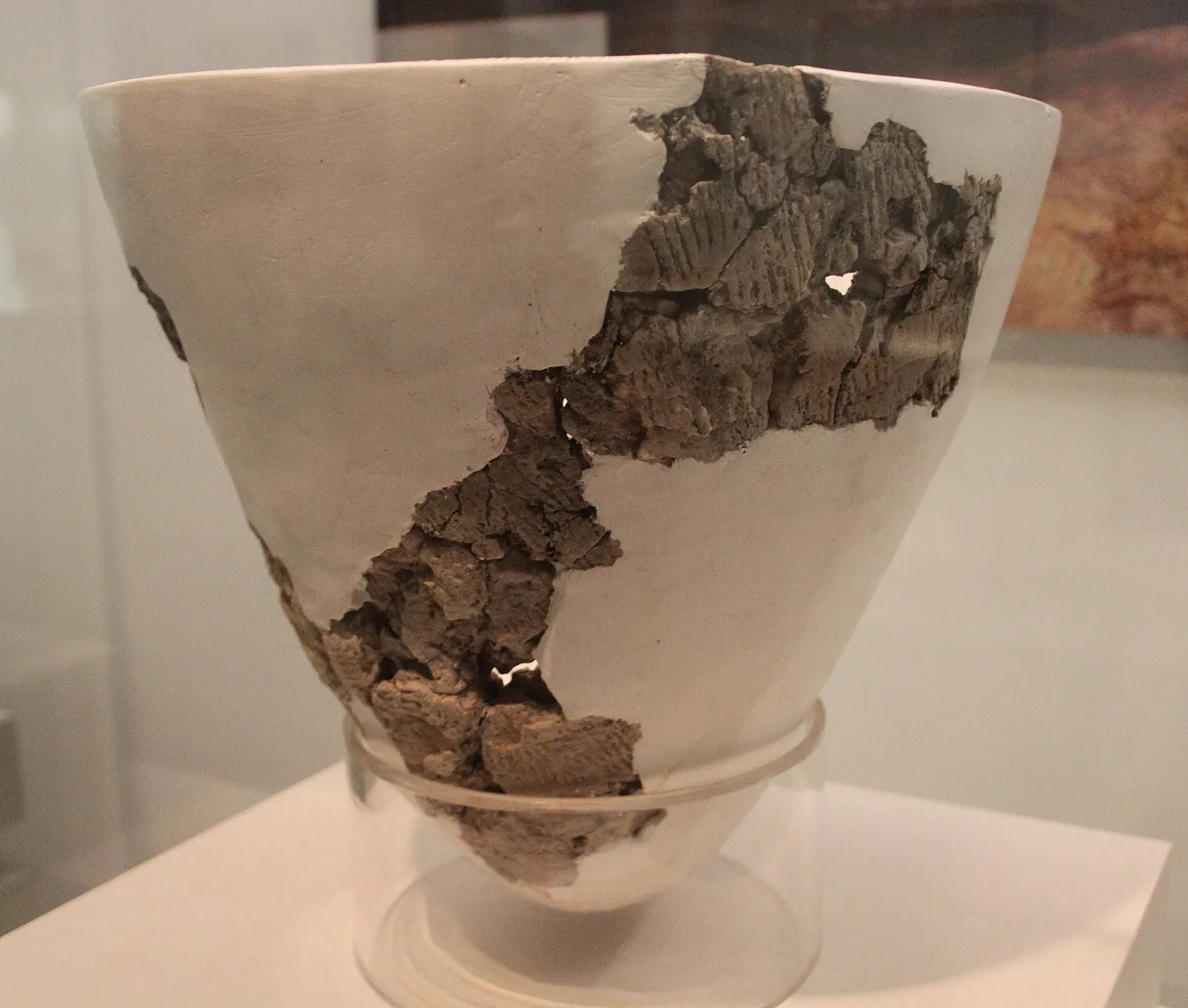
Pottery is clay shaped, dried and fired. Heated beyond roughly 500 °C, clay minerals lose the water bound into their structure, and the fired body no longer slakes back into mud; the change cannot be undone. In 2012 Wu Xiaohong and colleagues published dates from Xianrendong Cave in Wannian, Jiangxi, showing that the oldest sherds there are about 20,000 to 19,000 years old, dated by bone and charcoal from the same layers; their makers were mobile foragers of the Last Glacial Maximum. Early pottery from Yuchanyan in Hunan and Odai Yamamoto I in northern Japan falls between about 18,000 and 16,000 years ago, and lipids from early Jōmon pots show that they were used to cook fish and other aquatic foods. Fired clay itself is older still: figurines from Dolní Věstonice in Moravia date to about 30,000 years ago, though they are not vessels. Western Asia ran the other way. Farming began there around 9500 BCE but pottery only around 7000 BCE, which is why archaeologists speak of a "Pre-Pottery Neolithic". Ounjougou in Mali had pottery by about 9400 BCE, and the Americas had origins of their own. Pots served for boiling, storage and fermentation; kiln heat, clay moulds and crucibles later prepared the way for casting copper, and Shang bronzes were cast in ceramic piece-moulds.
Connections
Causes1
- Control of FireenablesClay becomes ceramic only when fired
Consequences1
- CastingenablesKiln heat, clay moulds and crucibles prepared the way for casting; Shang bronzes were cast in ceramic piece-moulds
Echoes1
- The Origins of Agriculture (Neolithic Revolution)echoesIn East Asia pottery preceded farming by some ten thousand years: containers were not a by-product of agriculture
Sources
- Wu Xiaohong et al., Early Pottery at 20,000 Years Ago in Xianrendong Cave, China (Science 336) (2012)
- Oliver E. Craig et al., Earliest evidence for the use of pottery (Nature 496) (2013)
- Eric Huysecom et al., The emergence of pottery in Africa during the tenth millennium cal BC: new evidence from Ounjougou (Mali) (Antiquity 83) (2009)
Open questionswell attested
- The Xianrendong sherds are dated by bone and charcoal from the same layers; the sherds themselves have not been dated directly.
- The date of the Odai Yamamoto I site depends on calibration, and published figures vary.
- The uses of early pottery are inferred mainly from residues.
- How many times pottery was invented independently is unresolved.
Why it matters
Pottery's dates overturned a long-standing story. One would expect people to settle and farm before they needed pots, and Chinese tradition credited the mythical Shennong with both ploughing and pottery; yet Xianrendong and the Japanese sites show East Asian foragers firing clay to cook in the depths of the last ice age, some ten thousand years before crops were cultivated, while in Western Asia farming came first. Containers and agriculture were separate lines of technology that met later. Pottery was also among the first artificial materials made in quantity, and what potters learned about kiln temperature, clay recipes and firing atmosphere flowed into metallurgy, glass and porcelain. Because sherds almost never decay and their styles change with time and place, much of archaeology's chronology and its map of ancient cultures is built on broken pots.