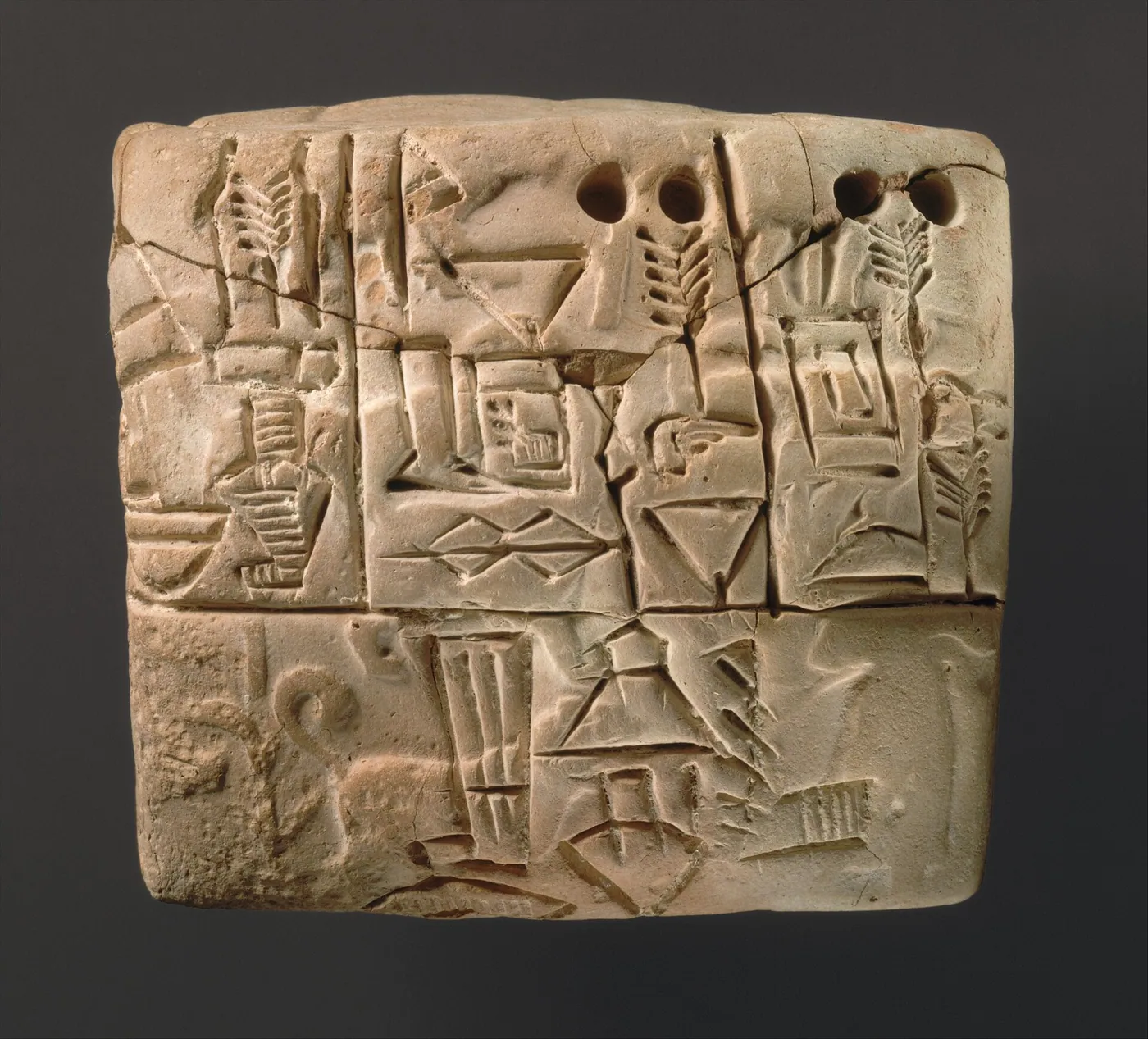
The writing system developed by the Sumerians of Mesopotamia around 3400–3200 BCE, whose wedge-shaped strokes were pressed into wet clay with a reed stylus. It began in temple-economy accounting (recording grain, livestock, and labour) and expanded to law, literature, astronomy, and diplomacy, serving for nearly three millennia across Akkadian, Babylonian, Assyrian, and Hittite. It is among the earliest known fully developed scripts.
I have read cunningly written Sumerian and obscure Akkadian, and deciphered stones inscribed from before the Flood.
—— Colophon of King Ashurbanipal (Nineveh, 7th c. BCE)
History
Around 3400–3200 BCE the Sumerian city-states of southern Mesopotamia developed cuneiform. Scribes pressed a cut reed stylus into wet clay, leaving the wedge-shaped strokes that give the script its name. The earliest tablets are almost all accounts: so much barley received by a temple, so many sheep delivered by a man—writing's first task was bookkeeping, not narrative. Over centuries the signs grew from pictures to abstractions able to record the syllables of Sumerian, and were then borrowed for Akkadian, Babylonian, Assyrian, Hittite, Elamite and more, and used for law codes (Hammurabi), epic (Gilgamesh), astronomy, and diplomacy (the Amarna letters). It served for nearly three thousand years, its last datable tablet around 75 CE. In the 19th century Grotefend made the first readings of Old Persian cuneiform from inscriptions at Persepolis, and Rawlinson and others, working from the trilingual Behistun inscription in Persia, gradually deciphered the sleeping script.
Connections
Causes1
- The Origins of Agriculture (Neolithic Revolution)enables · disputedSurplus and storage called forth marks for counting, a scholarly commonplace rather than a strict causal claim
Consequences1
- Babylonian AstronomyenablesCenturies of sky records survived because they were written on clay
Echoes2
- The Phoenician AlphabetechoesMesopotamian cuneiform and the Mediterranean alphabet are not a direct lineage: the alphabet descends from Egyptian hieroglyphs, and writing did not evolve along a single line
- The TelegraphechoesTelegraph literally means “writing at a distance”
Sources
- Steven Roger Fischer, A History of Writing
- Irving Finkel & Jonathan Taylor, Cuneiform
- Cuneiform
Open questionswell attested
- The mainstream view dates the origin of cuneiform to c. 3400–3200 BCE, but its earliest possible date is disputed.
- Ashurbanipal's inscription is royal self-praise, and the wording quoted is a paraphrase in translation.
- The bookkeeping origin (Schmandt-Besserat's token and envelope theory) is the mainstream hypothesis but is not uncontested.
Why it matters
Cuneiform punctures a romantic notion: writing was born not of poets' or priests' inspiration but in the ledgers of bureaucracy and the storehouse. Its first users were scribes counting barley and sheep; just as print's first heavy users were Buddhists, a technology's first push often comes from mundane practice. It is also a case of independent origin: Mesopotamian cuneiform, Nile hieroglyphs, Yellow-River oracle bones, Mesoamerican Maya glyphs—writing was invented by humanity at least several times over, with no single source. This is what anti-Whig history prizes: writing was not one place's gift, "diffused" to the rest of the world.