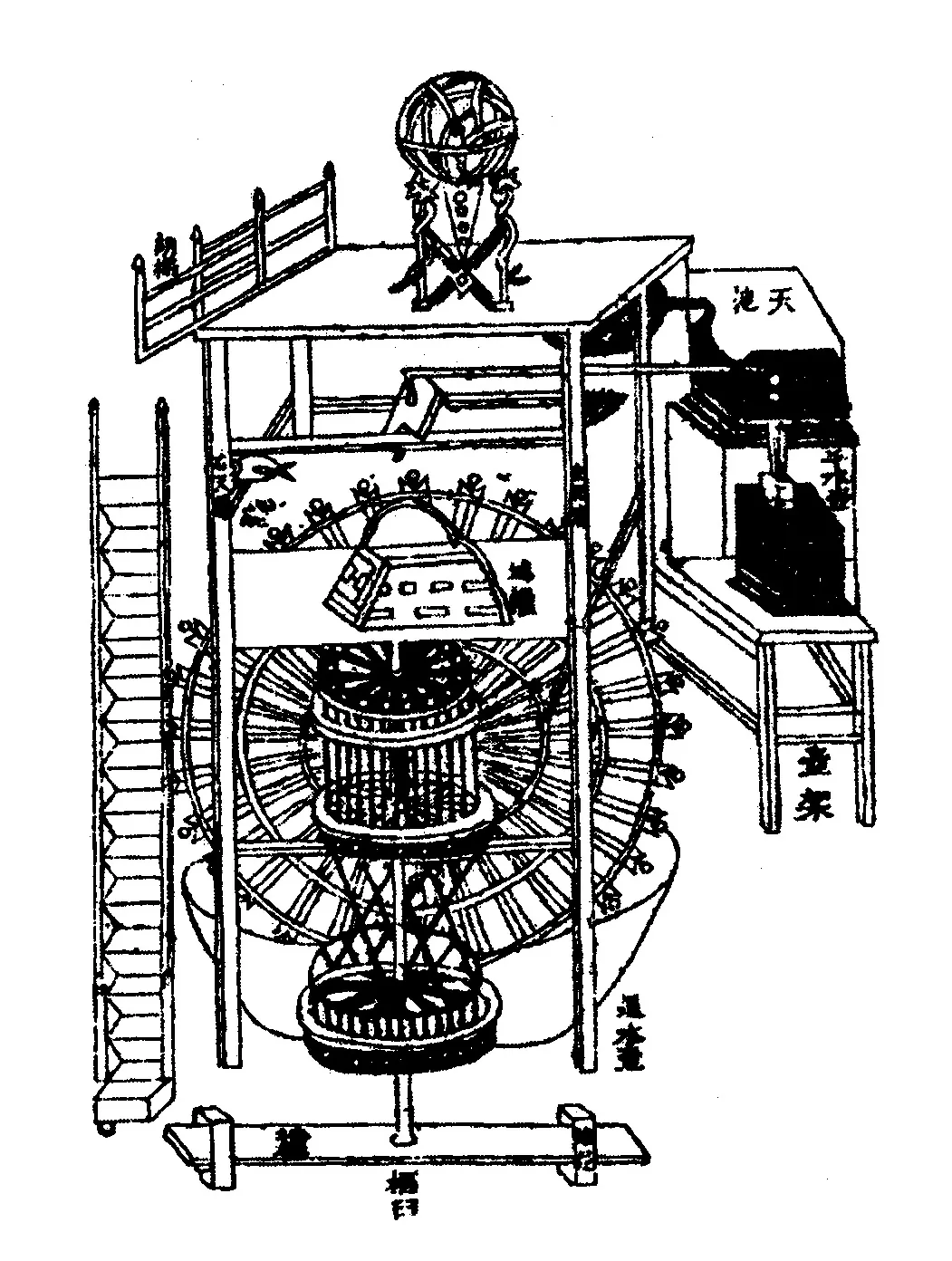
A timekeeper driven by a falling weight and divided by an escapement. Its crux is not the drive but the escape—a mechanism that lets the train advance and arrests it in turn, converting a continuously falling weight into countable, equal beats. In China the astronomical clock tower of Su Song (wooden models 1088, completed 1092) had realized the same principle with a water wheel and its 'celestial balance,' though that tradition did not continue; weight-driven mechanical clocks appear in Europe between about 1270 and 1300, serving first the appointed prayers of monasteries and then the towers of towns. The change they brought was not accuracy (early mechanical clocks might err a quarter-hour a day, far worse than sundial or clepsydra) but the replacement of unequal hours that stretched and shrank with the seasons by equal hours of the same length all year: time thereby became something that could be allotted and sold apart from the rhythm of nature.
Then, as a horologe that calleth us / What time the Bride of God is rising up / With matins to her Spouse that he may love her, / Wherein one part the other draws and urges, / Ting! ting! resounding with so sweet a note, / That swells with love the spirit well disposed…
—— Dante, Paradiso X.139–144 (c. 1320), trans. Henry Wadsworth Longfellow
History
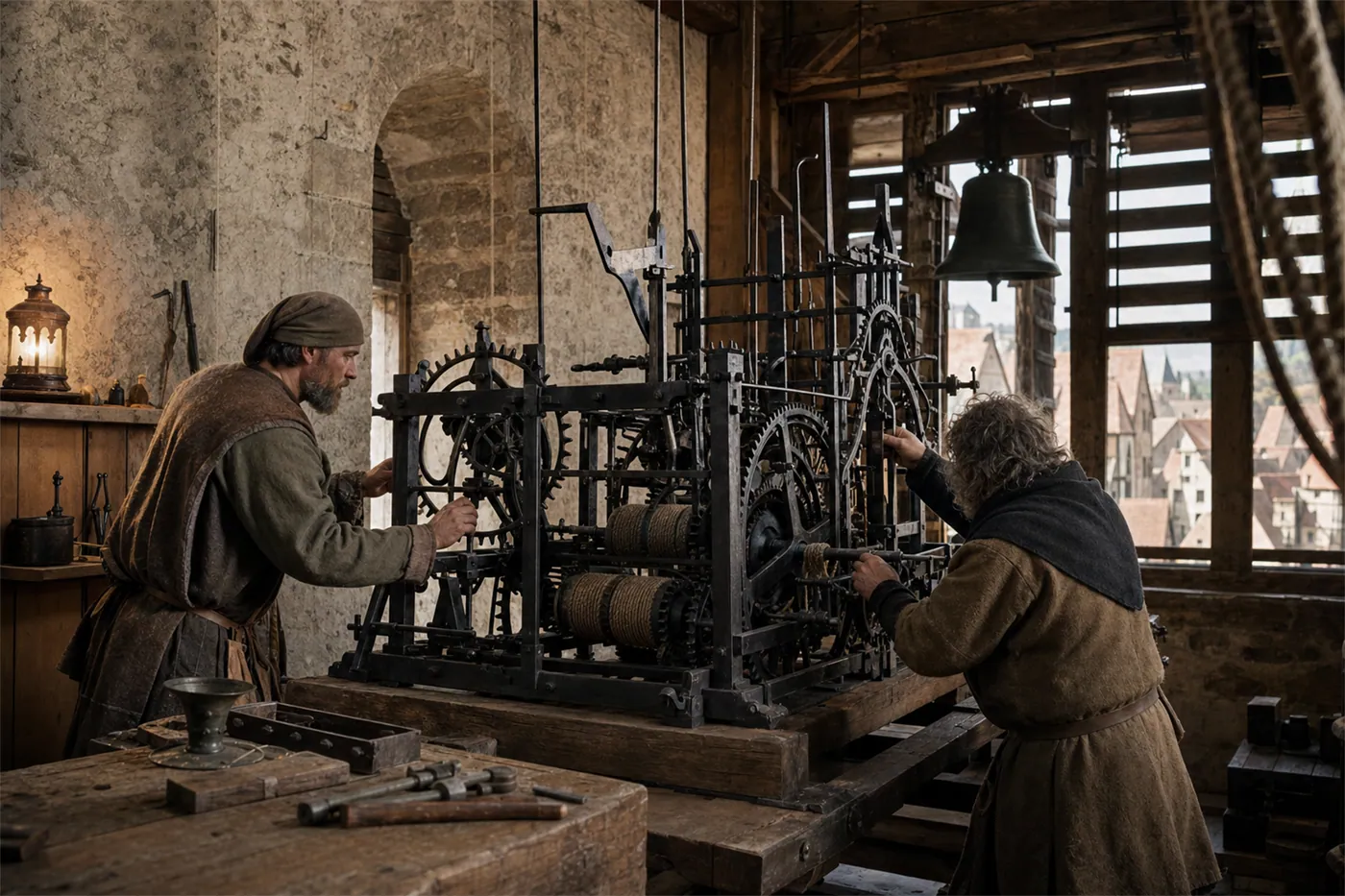
The difficulty of timekeeping is not to set something moving but to make it move evenly. A water clock approximates evenness by the steadiness of flow, and in antiquity did so quite well, but it is sensitive to temperature and to the water itself, and it drives complex striking work only with difficulty. The breakthrough is the escapement: a mechanism that periodically releases and arrests the train, cutting a continuous drive into equal beats. The astronomical clock tower built at Kaifeng by Su Song and his collaborators (wooden models in 1088, the tower completed in 1092) realized the principle with a water wheel filled by measured amounts and a 'celestial balance' lever, carrying an armillary sphere, a celestial globe, and jacks that announced each quarter—among the most complex machines then existing anywhere. The tower was dismantled and carried north after the fall of Kaifeng, and the tradition was not continued in China. European mechanical clocks appear between about 1270 and 1300, weight-driven with a verge-and-crown-wheel escapement; none survives, and the earliest evidence is incidental notice in monastic accounts and chronicles. Monasteries were the first users: seven appointed offices by day and night required someone to ring the community awake on time, and the clock automated the duty. From the fourteenth century towns began mounting great clocks in their towers, so that watch, market, work, and curfew had a public signal at no one's discretion. Accuracy remained poor (a quarter-hour a day was ordinary, and sundials were used to reset them) until Huygens applied the pendulum in 1656 and brought the daily error to tens of seconds, and Harrison's marine chronometer of 1761 settled the outstanding problem of longitude at sea.
Connections
Consequences2
- The Scientific Revolutionenables · disputedOn Landes's view the public hour and the clockwork cosmos aided the new science; critics note that China had more complex timekeeping without that outcome
- The Mechanical PhilosophyinspiresThe metaphor of the world as a clock
Echoes2
- The Antikythera MechanismechoesPrecision gearing lost and found again
- Su Song's Astronomical Clock TowerechoesIts escapement preceded European clocks by some two centuries, with no known line of transmission
Sources
- David S. Landes, Revolution in Time: Clocks and the Making of the Modern World
- 李约瑟(Joseph Needham)等, 《中国科学技术史》第四卷第二分册·机械工程(水运仪象台)
- Stephen Kern, The Culture of Time and Space, 1880–1918
- Clock
Open questionspartly uncertain
- The exact date and place of Europe's first mechanical clock cannot be established; the documentary references from 1270 to 1300 are mostly indirect, and no example survives.
- There is no evidence that the escapement of Su Song's astronomical clock tower and that of European weight-driven clocks are linked by descent; the mainstream view treats them as independent inventions, to be set side by side without assuming transmission.
- Landes's thesis that clock discipline produced modernity has been very influential, but critics say it reads motives back from consequences and underrates the separate needs of monasteries and commercial towns, and it remains disputed.
- Figures for the daily error of early mechanical clocks come from a few reconstruction experiments and indirect records; their order of magnitude is credible, but precise values are unreliable.
Why it matters
In Revolution in Time, David Landes argued that the mechanical clock made modernity: the public hour bred punctuality, discipline, and the economic reckoning of time, which are the psychological preconditions of capitalism and industrial society. The thesis is handsome and not without evidence—factory hours, railway timetables, and wages paid by the hour do all presuppose the equal hour. It must be read with two criticisms. The first is the suspicion of reading causes off consequences: monasteries wanted clocks so that prayer would be punctual, not to cultivate an economic man; towns wanted them to coordinate civic business, not to prepare an industrial revolution, and taking the later outcome for the original motive is the commonest fault in the history of technology. The second is the counter-instance: China possessed more complex timekeeping machinery and no modernity followed, while equal hours were general in Europe for three or four centuries before the factory arrived; if the clock were the cause, the delay is unaccountable. What can safely be said is narrower: the mechanical clock did not create discipline, it supplied the form in which discipline could be externalized. Before it, "it is time" was said by a particular person: priest, foreman, watchman. After it, the sentence was said by a device belonging to no one. The substitution carries no moral tendency in itself, yet it lends every arrangement that requires punctuality of others an impersonal and seemingly neutral authority. Everything since, from the factory whistle to the time clock, from the railway timetable to the meeting reminder in today's calendar software, has drawn on that authority.