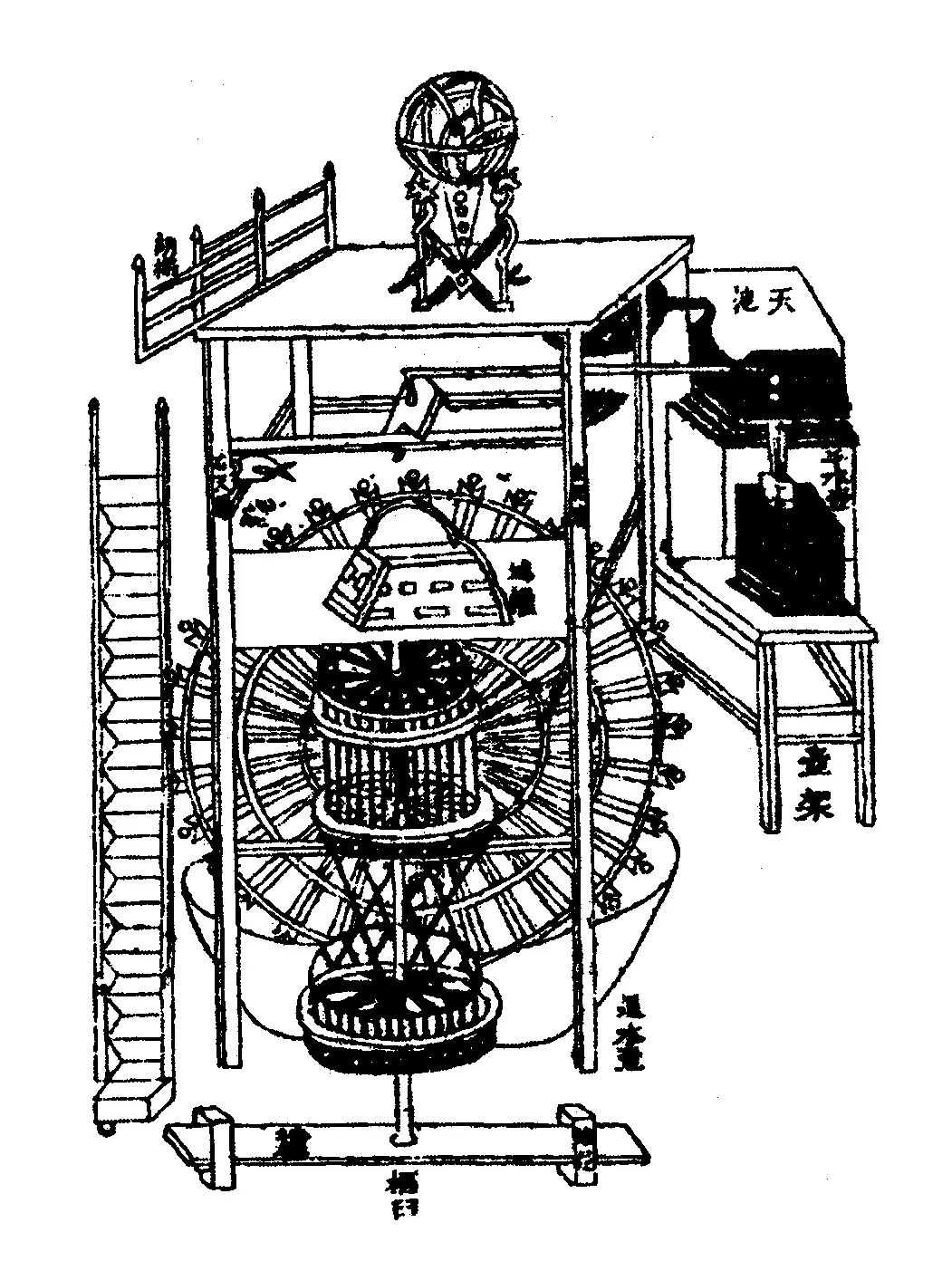
A water-driven astronomical clock built at Kaifeng by Su Song and Han Gonglian and completed in 1092. Some 12 m high, it carried an armillary sphere, a celestial globe and time-announcing jacks, driven by a water wheel and an escapement.
A tower of three levels: an armillary sphere above, a celestial globe in the middle, time-keepers below, all joined to one mechanism. Water drives the wheel without human effort, and when an hour or a quarter arrives the time-keepers come out to announce it.
—— Song shi (History of the Song, 1345), ch. 340, biography of Su Song
History
The tower was a water-driven timber structure combining observation, demonstration of the heavens and timekeeping. In late 1086 Su Song was ordered to review the court's armillary spheres and recommended Han Gonglian as designer. A bureau was set up in 1087; in 1088 it produced a small model and then a full-size wooden one, installed in the Jiying Hall and tested day and night. In 1089 the emperor ordered it made in bronze, and in mid-1092 the finished machine was shown to the chief ministers. On the top platform, under a removable roof, stood the armillary sphere; in the middle chamber a celestial globe turned with the sky; at the front, a five-storey pagoda of jacks rang bells, struck drums and held up tablets for the hours and quarters. The power came from a scoop wheel eleven chi (about 3.4 m) across with 36 buckets. Water flowed in at a steady rate; each time a bucket filled to a set weight it tripped a train of levers, the "celestial balance" and "celestial lock", which let the wheel advance one step and then held it again, what Joseph Needham called a water-wheel linkwork escapement. An iron chain, the "celestial ladder", carried the motion up to the armillary sphere. After the Jin took Kaifeng in 1127 they carted the tower to Yanjing (Beijing); the clockwork was gradually discarded, and even the bronze sphere was abandoned when the Jin moved south in 1214.
Connections
Causes1
- Su SongcontributedDirected its construction and described it in the Xin Yixiang Fayao
Echoes2
- The Mechanical ClockechoesIts escapement preceded European clocks by some two centuries, with no known line of transmission
- The Antikythera MechanismechoesTwo geared machines for showing the heavens, East and West, with no known connection
Sources
- Joseph Needham, Wang Ling and Derek J. de Solla Price, Heavenly Clockwork: The Great Astronomical Clocks of Medieval China (2nd ed., with supplement by John H. Combridge, 1986) (1960)
- 苏颂, 新仪象法要(四库全书本) (约1094—1096)
- 王应麟;脱脱等, 玉海·卷四“元祐浑天仪象”;金史·历志下(卷二十二) (13世纪;1344)
- David S. Landes, Revolution in Time: Clocks and the Making of the Modern World (1983)
Open questionspartly uncertain
- The height of about 12 metres is a reconstructed figure calculated from the dimensions given in Su Song's treatise.
- The months in which the wooden model and the bronze instruments were completed are taken from the Huiyao (Song institutional records) as quoted in the Yuhai compendium.
- Whether its escapement can be compared with the escapement of European mechanical clocks is disputed.
- The record of a failed attempt to reproduce it under the Southern Song is found in the treatise on astronomy of the Song shi (History of the Song).
Why it matters
Discussion tends to fix on the escapement. Joseph Needham saw it as the forerunner of the European clock escapement and speculated that word of it reached the West; David Landes called that speculation unfounded and stressed that its rate still came from a steady flow of water, the escapement merely releasing the water in equal weights, unlike Europe's oscillating escapements. No route of transmission is known. Less disputed is what the tower was for. It was an instrument of the imperial astronomical bureau, used to check the sky, support the calendar and display the dynasty's mandate, not to tell the public the time, so its fate followed the regime's. In the 1130s the Southern Song court summoned Su Song's son to rebuild it from his father's book and failed; Zhu Xi also tried, and the History of the Song notes that the book omits most dimensions. Every working tower today, like the full-size replica in Taichung, is a modern reconstruction.