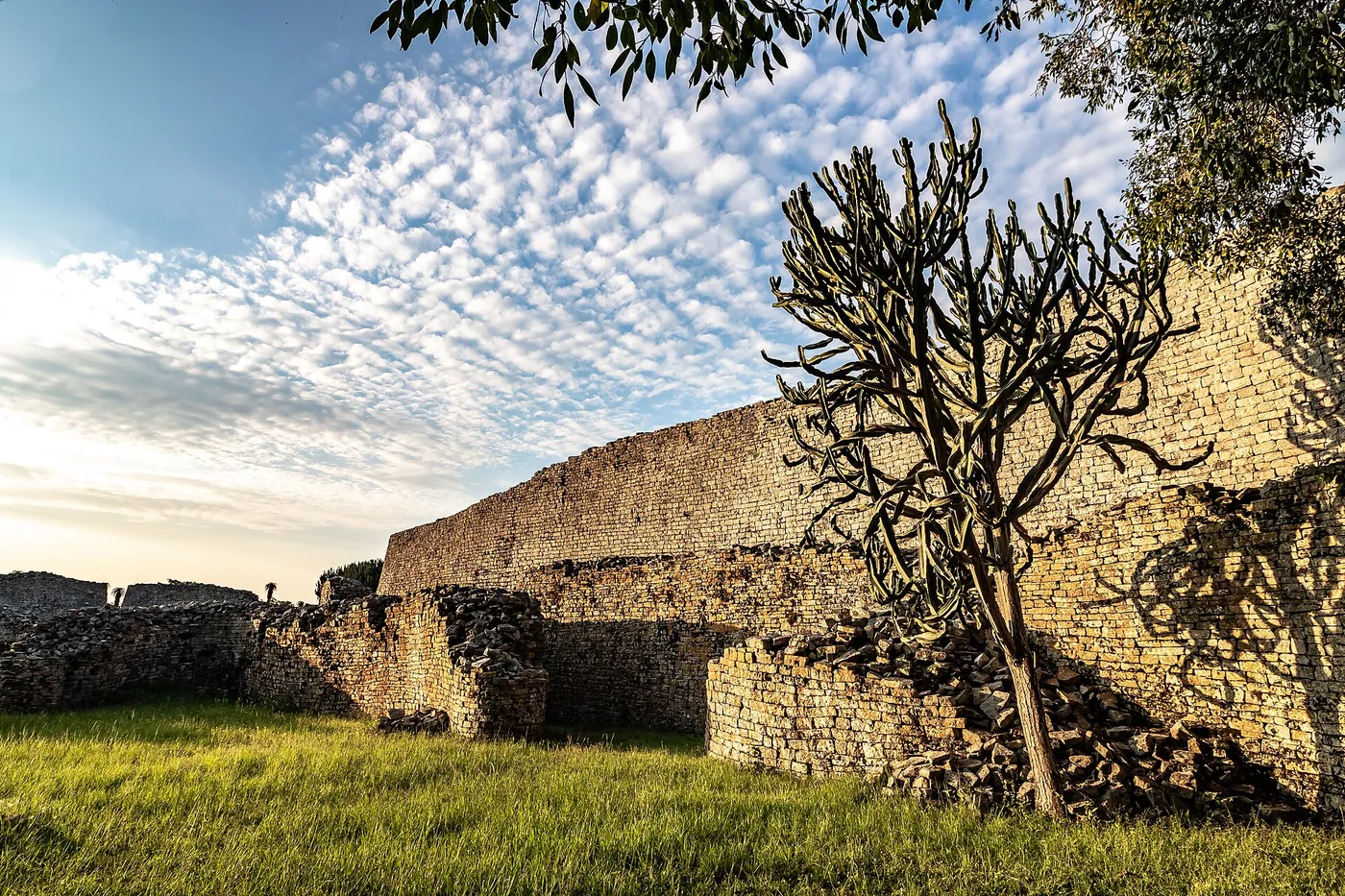
A stone city built by Shona people on the southeastern plateau of present-day Zimbabwe between the eleventh and fifteenth centuries, capital of the Kingdom of Zimbabwe and home at its height to perhaps ten thousand or more. Its walls are dry-laid from squared granite blocks without mortar; the outer wall of the Great Enclosure runs some 250 metres and stands up to about 11 metres, the largest ancient structure surviving in sub-Saharan Africa. Chinese celadon, Persian ceramics, Arab coins, and much gold work have been excavated on the site, showing its connection through Sofala and Kilwa to the Indian Ocean trade, gold and ivory going out for goods coming in. From the late nineteenth century its African authorship was systematically denied—the Rhodesian authorities favouring Phoenicians or the Queen of Sheba, and imposing censorship in the 1970s on archaeologists who concluded otherwise. The denial was refuted long ago in scholarship; the manner of its refutation is a standard case of archaeology in the service of politics.
Among these edifices there is one, built of stones of marvellous size, and there appears to be no mortar joining them … the natives of the country do not know how they were built, nor by whom.
—— João de Barros, Décadas da Ásia (1552), reporting accounts of the inland stone city
History
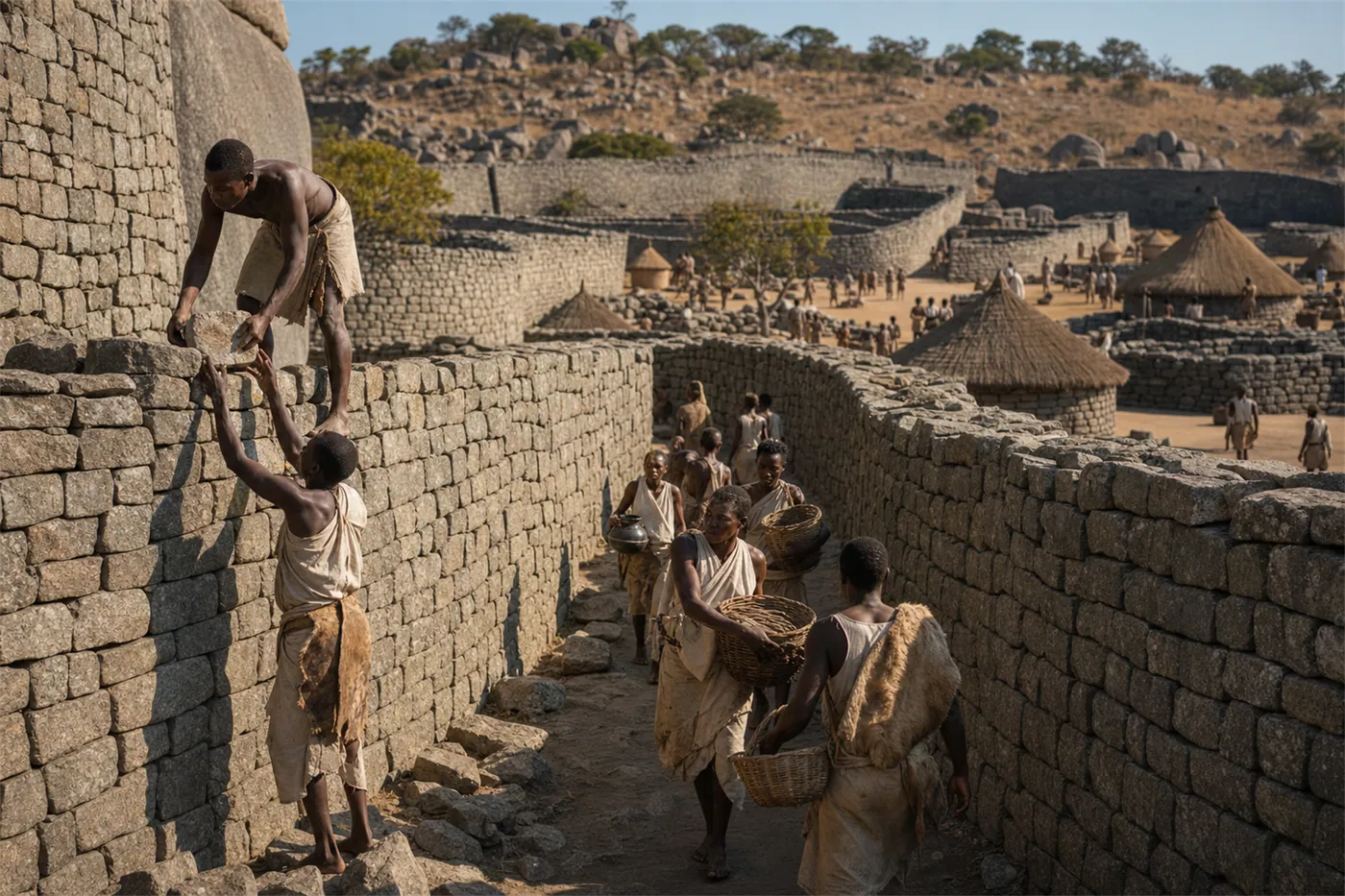
Great Zimbabwe stands on the plateau between the Limpopo and the Zambezi in the southeast of the present country, some eleven hundred metres above sea level, and is what the Shona words dzimba dza mabwe (houses of stone) refer to. Building began in the eleventh century on the hill, reached its height in the thirteenth and fourteenth, and comprises the Hill Complex, the Great Enclosure, and the settlement in the valley between. Its masonry is dry-laid: granite split along its natural sheeting into slabs, dressed to blocks of like size, and coursed with staggered joints without any binder, its stability resting on form and weight alone. The finest stretches are laid to a line and finished at the top with a chevron band. The method demands much in the selection and dressing of stone and nothing at all of mortar technology—this is not architecture lacking mortar but another solution to the problem of stability. Economically the city commanded the road between the goldfields and the eastern ports: gold and ivory went down to Sofala and Kilwa, and cloth, glass beads, and porcelain came back. The Chinese celadon, Persian glazed ware, and Arab coins from the site are direct evidence of that route. The city declined in the fifteenth century, its people dispersed, and the political centre moved north to Mutapa. Portuguese on the coast heard in the sixteenth century of a stone city inland, and Barros's notice comes from such reports. When Rhodes's British South Africa Company entered the region at the end of the nineteenth century, an account promptly appeared: such building was beyond local capacity and must be the work of Phoenicians or of the Queen of Sheba. David Randall-MacIver in 1905 and Gertrude Caton-Thompson in 1929 established from stratigraphy and finds that it was medieval and African, and scholarship has held so since; yet the Rhodesian government required into the 1970s that official publications not state its African origin plainly, and archaeologists such as Peter Garlake were pressed for maintaining the contrary. In 1980 the new state took the city's name for its own.
Connections
Echoes1
- The Timbuktu ManuscriptsechoesTwo highly organized achievements of sub-Saharan Africa in the same centuries, one in stone and the gold trade, one in writing and manuscripts, both long denied or belittled by colonial scholarship
Sources
- Innocent Pikirayi, Great Zimbabwe: An Archaeological Investigation of an Ancient African City
- Peter S. Garlake, Great Zimbabwe Described and Explained
- Joost Fontein, The Mystery of Great Zimbabwe: The Contested Landscape and the Power of Heritage
- Great Zimbabwe
Open questionspartly uncertain
- The peak population of "perhaps over ten thousand" is an estimate based on settlement area and the density of house sites, and estimates range from a few thousand to 18,000.
- The function of the Great Enclosure (royal residence, site of initiation rites, grain store, or a combination of these) is unresolved, so no single interpretation is adopted.
- The causes proposed for the decline (falling environmental carrying capacity, the northward shift of trade routes to Mutapa, political fragmentation) each have advocates and are not mutually exclusive, so they are listed side by side without ranking.
- The early excavations (Bent in 1891, Hall in 1902) badly disturbed the site and left incomplete stratigraphic records, so the context of a number of finds can no longer be reconstructed; this is both a limitation of the evidence and a direct consequence of colonial archaeology.
Why it matters
The city's place in the history of technology has two layers, one concerning the stone and one concerning what has been said about the stone. The first is not complicated: dry-stone construction is a mature building technique whose demands on the properties of materials (how to take slabs along the sheeting, how to proportion blocks so that a wall stands) are no lighter than those of any mortared method; it simply refers the problem of stability to geometry and weight rather than to chemistry. To judge it by an inability to use mortar is like judging Stone Age flintwork by an inability to use iron: measuring what someone did solve against a problem they did not set. The second layer matters more. The mystery of Great Zimbabwe after 1891 was not created by a shortage of evidence but manufactured: colonial rule required a premise, that the local population was incapable of complex society, and this city was the premise's refutation, so it had to be renamed. What followed gave the history of technology a rare and almost controlled observation: the same site and the same finds yielded one conclusion under a colonial government's patronage and another under independent scholarly scrutiny, and the latter, which had the evidential advantage from 1905 onward, still took seventy years to become sayable in public. Sufficient evidence and a statable conclusion are two different things, and between them lies a variable that does not usually appear in textbooks of method.