The accounting method in which every transaction is entered as equal debit and credit, so the books self-balance and error or fraud become detectable. Matured in Renaissance Italian commerce and given lasting systematic publication in Luca Pacioli's Summa de arithmetica (1494). It is the ledger-bedrock of modern commerce, the firm, and capitalism (Sombart's thesis that it engendered capitalism is contested).
Double-entry bookkeeping… is among the finest inventions of the human mind.
—— Goethe, Wilhelm Meister's Apprenticeship (1795–96), spoken by the character Werner, spoken by the character Werner
History
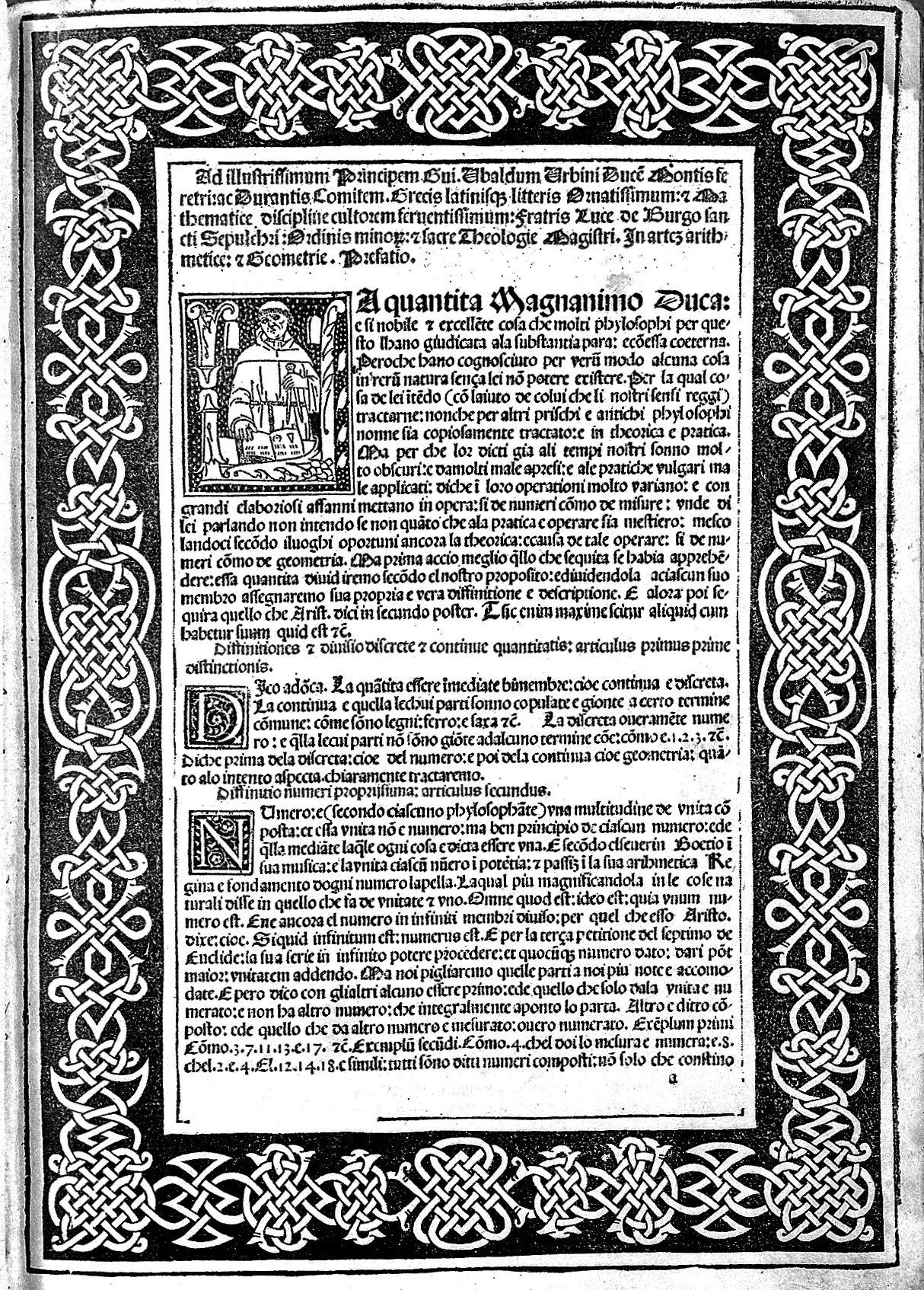
The core of double-entry is that every transaction is recorded twice, once as debit and once as credit, equal in amount and opposite in direction, so that the sums of all debits and credits must be equal; the ledger can thus check itself, and a single error throws the two sides out of balance. The method matured in the practice of the Italian commercial city-states (Venice, Florence, Genoa) in the 13th–14th centuries, serving the complex accounts of partnerships, bills of exchange, and overseas trade. In 1494 the Franciscan friar and mathematician Luca Pacioli devoted a section of his Summa de arithmetica to a systematic account of the Venetian merchants' method; carried by the new printing, it spread across Europe and became the classic template for later double-entry (Pacioli is thus called the "father of accounting," though he was its recorder, not its inventor). The method became the ledger-skeleton of the modern firm, the bank, and even state finance.
Connections
Causes2
- Hindu–Arabic NumeralsenablesEasy pen-reckoning numerals paved the way for commercial arithmetic and double-entry bookkeeping
- The Printing RevolutionenablesPacioli's Summa was printed; double-entry was standardized and spread through Europe by print
Sources
- Jacob Soll, The Reckoning: Financial Accountability and the Rise and Fall of Nations
- Luca Pacioli, Summa de arithmetica (1494)
- Double-entry bookkeeping system
Open questionspartly uncertain
- It is well established that Pacioli published a systematic account of the method in 1494 and that Italian commercial practice came first.
- The thesis that double-entry bookkeeping gave rise to capitalism (in the tradition of Sombart and Weber) is famous but much disputed.
- Earlier Islamic and Indian precursors have also been discussed by scholars.
Why it matters
Double-entry is easily slighted but has strong credentials in the history of technology. Like cataloguing, it is one of the invisible information technologies: it produces no wealth, but produces reliable knowledge of wealth, letting a firm or a state truly "see" its own income and outgo. It also touches a famous problem in the history of ideas. The Sombart–Weber line argued that the "rational calculation" mindset trained by double-entry was one condition for the rise of capitalism, an influential but much-contested claim: bookkeeping long predated capitalism, and the causation is hard to pin down. The method's diffusion owed something to the Hindu–Arabic numerals, which made written reckoning easy, and to printing, which carried Pacioli's account across Europe.