The plague pandemic of 1346–1353, caused by Yersinia pestis, that swept western Eurasia and North Africa. Europe is estimated to have lost between a third and a half of its people; the Middle East and North Africa suffered on a similar scale.
And I, Agnolo di Tura ... buried my five children with my own hands. ... There was no one who wept for any death, for all awaited death. And so many died that all believed that it was the end of the world.
—— Agnolo di Tura del Grasso, Cronaca senese, entry for 1348; trans. William M. Bowsky, The Black Death: A Turning Point in History? (1971), pp. 13–14
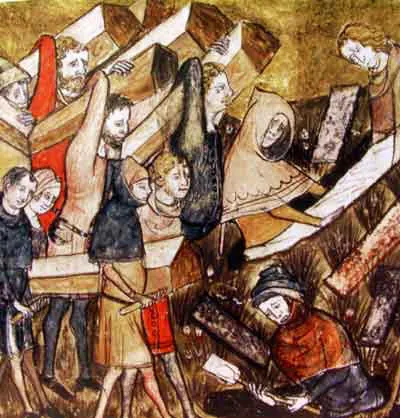
History
The Black Death was the pandemic of plague that swept western Eurasia and North Africa in 1346–1353. Its agent, the bacterium Yersinia pestis, usually passes from rodents to humans through fleas, and in its pneumonic form directly between people; how far human fleas and lice spread the Black Death is still debated. In 2011 Kirsten Bos and colleagues reconstructed its genome from victims buried in 1348–1350 at East Smithfield in London; in 2022 Maria Spyrou and colleagues found an ancestral strain of the Black Death lineage in graves in the Chüy valley of Kyrgyzstan, whose tombstones record deaths from "pestilence" in 1338–1339, pointing to an origin in the Tian Shan region. The disease travelled west along the trade routes. In 1346 it appeared at Caffa in the Crimea, then besieged by an army of the Golden Horde; Gabriele de' Mussis, a notary of Piacenza, wrote that the besiegers catapulted infected corpses into the town, but his account is secondhand and uncorroborated. Genoese galleys brought plague to Messina in Sicily in October 1347, and it reached Alexandria that autumn. In 1348 it spread through Italy, France, Egypt and Syria and reached England in the summer; in 1349–1351 it swept Germany, Scandinavia and eastern Europe, and it reached Moscow in 1353. Estimates of mortality in Europe usually run from 30 to 50 percent; in Siena the mortality began in May 1348, and Cairo and Damascus lost tens of thousands.
Connections
Consequences2
- The Printing Revolutioninspires · disputedSome historians argue that the population collapse raised the cost of copying and so the demand for print
- The Germ Theory of DiseaseinspiresIn 1894 Yersin isolated the plague bacillus, explaining the Black Death in the terms of bacteriology
Sources
- Kirsten I. Bos et al., A draft genome of Yersinia pestis from victims of the Black Death (Nature 478) (2011)
- Maria A. Spyrou et al., The source of the Black Death in fourteenth-century central Eurasia (Nature 606) (2022)
- Rosemary Horrox (ed. and trans.), The Black Death (Manchester Medieval Sources) (1994)
- David Herlihy, ed. Samuel K. Cohn Jr., The Black Death and the Transformation of the West (1997)
Open questionspartly uncertain
- The story of corpses being thrown into Caffa comes from a second-hand account by de' Mussis and is uncorroborated.
- How much of the transmission was due to rat fleas and how much to human parasites is debated.
- Mortality rates are estimates and varied greatly from place to place.
- The conclusion that the plague originated in the Tian Shan rests on a small number of samples.
- Herlihy's argument that labour shortages encouraged labour-saving technology and printing is disputed.
- Accounts of the number of Jews killed in the massacres in different cities vary.
Why it matters
Faced with the Black Death, people reached for the intellectual tools they had. In October 1348 the Paris medical faculty, reporting to the French king, traced the epidemic to a conjunction of Saturn, Jupiter and Mars in Aquarius on 20 March 1345 that had corrupted the air; the explanation saved no lives and was not abandoned. More effective measures came from city government. From 1377 Ragusa (Dubrovnik) isolated arrivals from infected places for thirty days, later commonly forty, which gave English the word quarantine. Fear also turned into violence. Flagellants marched in 1348–1349, and between 1348 and 1351 Jewish communities from Provence and Switzerland to the Rhineland were massacred as supposed poisoners. Scarce labour raised wages, and England's Statute of Labourers (1351) tried to hold them down. David Herlihy argued that dear labour pushed Europe toward labour-saving techniques, printing among them; the thesis is influential but rests on little direct evidence.