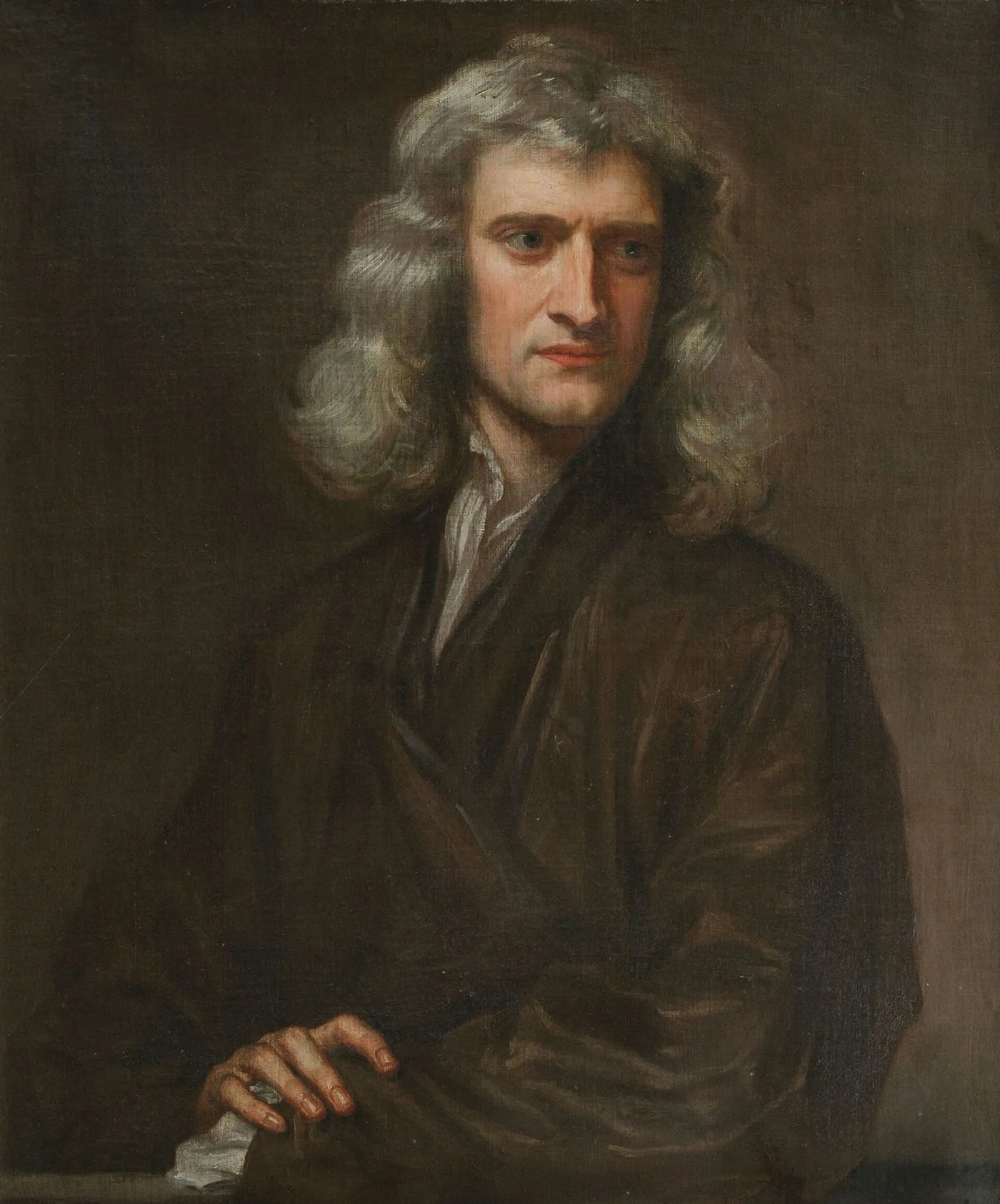
English natural philosopher whose Principia (1687) brought motion on Earth and in the heavens under three laws and universal gravitation; he also analysed colour with prisms, built a reflecting telescope, invented the calculus independently of Leibniz and ran the Royal Mint.
What Des-Cartes did was a good step. You have added much several ways, & especially in taking the colours of thin plates into philosophical consideration. If I have seen further it is by standing on the shoulders of Giants.
—— Newton to Robert Hooke, 5 February 1675/6, in H. W. Turnbull (ed.), The Correspondence of Isaac Newton, vol. I (1959); spelling partly modernized
History
Newton was born on Christmas Day 1642 by the old calendar (4 January 1643 by the new) at Woolsthorpe in Lincolnshire, and entered Trinity College, Cambridge, in 1661. While plague closed the university in 1665–66 he spent most of his time at home, developing his method of fluxions, experimenting with prisms and beginning to estimate the force that keeps the Moon in its orbit; the idea of a single miraculous year rests largely on recollections he wrote decades later during the priority dispute. He built a reflecting telescope in 1668, became Lucasian Professor in 1669, and in 1672 argued in the Philosophical Transactions that white light is a mixture of rays of different refrangibility, beginning a long quarrel with Robert Hooke. In 1684 Edmond Halley asked him what orbit an inverse-square attraction would produce; the answer grew into the Principia (1687), printed at Halley's expense. Appointed Warden of the Royal Mint in 1696, he ran the Great Recoinage and prosecuted counterfeiters, becoming Master in 1699; in 1717 he advised cutting the guinea from 21s 6d to 21s, after which silver drained abroad and Britain slid onto a de facto gold standard. He became President of the Royal Society in 1703, published Opticks in 1704, was knighted in 1705 and died in 1727. The falling apple appears in what he told William Stukeley in 1726, some sixty years after the event.
Connections
Consequences1
- Universal GravitationcontributedThe Principia (1687)
Sources
- Richard S. Westfall, Never at Rest: A Biography of Isaac Newton (1980)
- H. W. Turnbull (ed.), The Correspondence of Isaac Newton, vol. I (1661–1675) (1959)
- Thomas Levenson, Newton and the Counterfeiter (2009)
- John Maynard Keynes, Newton, the Man (in Newton Tercentenary Celebrations, Royal Society) (1947)
Open questionswell attested
- The idea of an "annus mirabilis" rests mainly on Newton's own recollections late in life (c. 1718).
- The apple story comes from a 1726 conversation recorded in Stukeley's manuscript of 1752, and also from Voltaire, who had it from Newton's niece.
- The 1717 revaluation led to a de facto gold standard, but whether Newton intended this is disputed.
- His birthday was 25 December 1642 in the Julian calendar and 4 January 1643 in the Gregorian.
Why it matters
Newton's image has been rewritten many times. The Enlightenment made him the embodiment of reason. When his private papers were sold at auction in 1936, John Maynard Keynes bought back a large share, and in a lecture prepared for the tercentenary of Newton's birth he called him "the last of the magicians". Newton left more manuscript on alchemy and theology than on physics; he believed the ancients had possessed truths since lost, and privately rejected the Trinity. Separating the scientist from the alchemist is a later habit. At the Mint he brought the same exactness to the weighing of coin, and in the priority dispute with Leibniz he steered the Royal Society committee that judged it. The "shoulders of Giants" had been a proverb since the twelfth century; Newton wrote it into a carefully courteous letter of reconciliation, and later readers turned it into a confession of modesty.