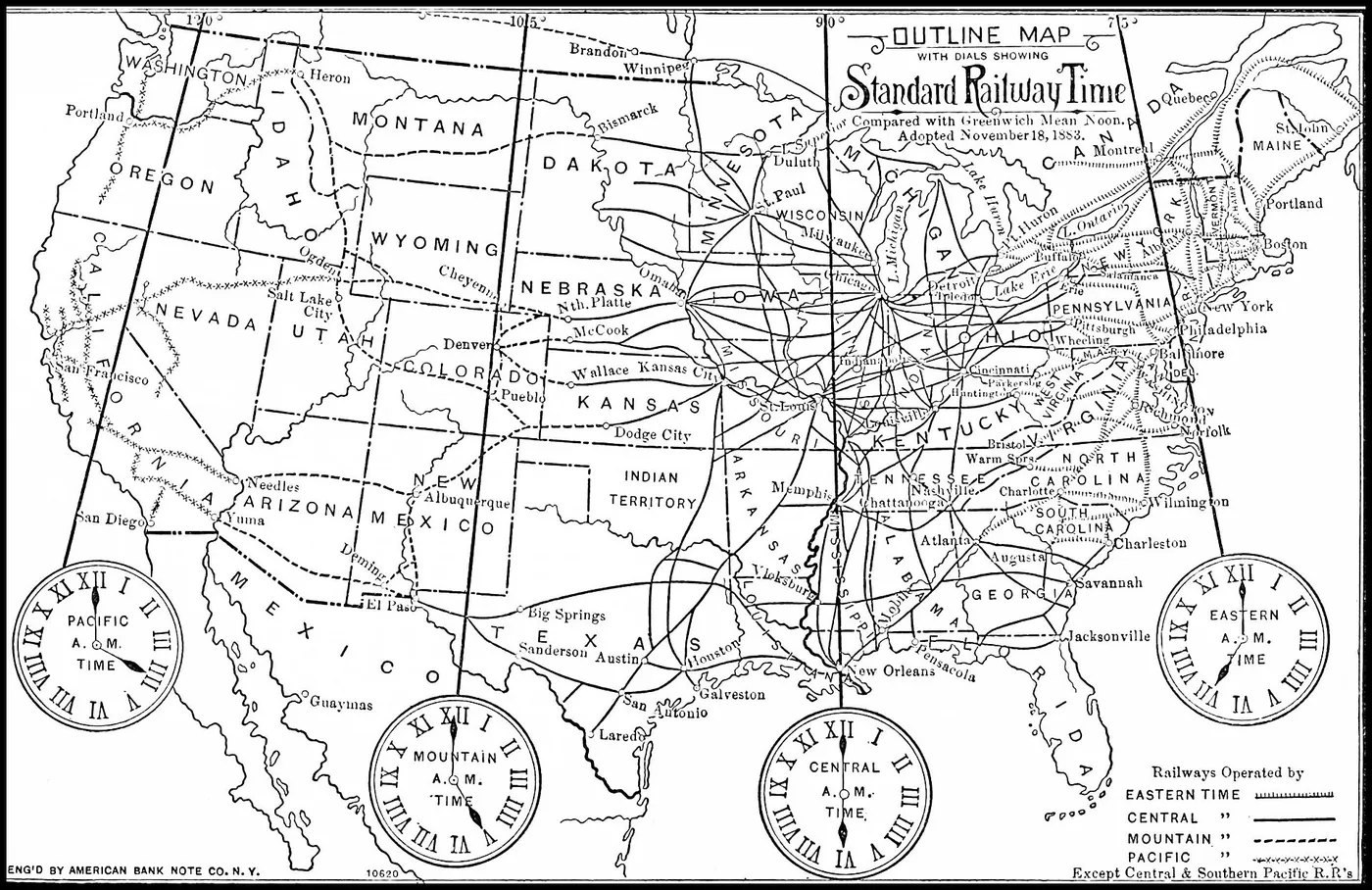
The institution of a common reference time in place of each locality's solar time. Before the railway, every town kept its own noon, four minutes apart for each degree of longitude, which mattered not at all in a world of walking and coaches. The railway made it a problem: if the stations along a line each kept local time, no timetable could be composed, and a train that was late was a train that might collide. British railway companies adopted Greenwich time across their systems from 1840 ("railway time"), and it became the legal time of the country in 1880. American railroads drew four time zones on their own authority in 1883, thirty-five years before Congress legislated. The International Meridian Conference at Washington in 1884 took Greenwich for the prime meridian and Greenwich midnight for the start of the universal day; time zones reckoned from it were then adopted country by country. In effect, so that machines might run on time, humanity redefined the present.
London time is about 4 minutes in advance of Reading, 7½ before Cirencester, 14 before Bridgwater.
—— Note in a Great Western Railway timetable (1841)
History
Local solar time is the most natural of all reckonings: noon is when the sun stands highest, and each place has its own. A degree of longitude is four minutes of noon; Britain spans some ten degrees, so its ends differ by nearly half an hour. In the age of the coach this was no problem—journeys were counted in days and a few minutes were imperceptible. The railway compressed journeys into hours, and the problem appeared: a train passing a dozen stations each keeping its own time made every figure in a timetable require a note as to whose clock it was. More seriously, single-track lines pass each other by the timetable, and if the two ends do not agree, passing becomes collision. In 1840 the Great Western adopted London (Greenwich) time across its system, other companies followed, and the phrase railway time was born. Many towns at first refused to move their clocks, and some church towers carried two minute hands, one for the town and one for the railway. In 1880 Parliament made Greenwich time the legal time of the country. The American case shows the difficulty more plainly still: a wider span of longitude, hundreds of railroad companies, and at one point more than fifty standards in use among them. On 18 November 1883 the major roads changed their clocks together on a scheme they had negotiated among themselves, dividing the country into four zones; the day was called the Sunday of Two Noons, and federal law caught up only in 1918. In 1884 delegates of twenty-five states met at Washington in the International Meridian Conference, took Greenwich for the prime meridian (France abstaining, and holding to Paris time for another two decades) and set the beginning of the universal day at Greenwich midnight; the twenty-four zones reckoned from it were adopted afterwards, country by country.
Connections
Causes2
- The RailwayinformsSingle-track lines pass by the timetable, so clocks that disagree risk collision; the railway companies adopted a common time before any legislation
- The TelegraphinformsThe telegraph carried Greenwich time signals to distant places, so that a common time could be enforced and not merely proposed
Sources
- Stephen Kern, The Culture of Time and Space, 1880–1918
- Peter Galison, Einstein's Clocks, Poincaré's Maps: Empires of Time
- Derek Howse, Greenwich Time and the Longitude
- Standard time
Open questionswell attested
- "Railway time" was introduced in Britain line by line and company by company, starting with the Great Western Railway in 1840, rather than nationwide at once.
- The 1884 International Meridian Conference adopted the prime meridian and the starting point of the day; full adoption of the twenty-four time zones was left to national legislation and took decades (France took Greenwich as its reference only in 1911).
- Drawing time-zone boundaries has never been a purely astronomical matter, since political and economic considerations often push them far from the meridians, so they should not be called a "scientific division".
- "Changing time for the sake of machines" is a generalisation: the telegraph, which made long-distance time checks possible, was a parallel condition, so the change should not be credited to the railways alone.
Why it matters
Standard time is an unusually clean instance of a technology requiring institutions to change. Clean, because the need was definite (avoid collisions, compose a timetable), the solution unique (one common reference), the resistance concrete (towns unwilling to move their own noon), and the outcome complete, since nowhere on earth now keeps local solar time. What deserves notice is the order in which it changed. Legislation did not come first with compliance after: the railway companies changed their own clocks, society adapted, and the law confirmed the result. Britain legislated forty years after railway time, the United States thirty-five. The sequence is very common in the history of technology: the operators of infrastructure often exercise in fact the effect of legislation, and formal law is largely the ratification of an accomplished fact. A second layer concerns whose time. Greenwich as prime meridian is not an astronomical conclusion, since physically any meridian will serve as zero. It followed from the fact that three-quarters of the world's shipping charts were already reckoned from Greenwich, and that fact followed from British sea power. France's abstention at the conference and its adherence to Paris time for two decades were less obstinacy than clarity about this. Peter Galison has shown that the unification of time was also an instrument of empire: the telegraph carried time signals to the colonies and the railway laid zones across the interior, so that one centre's present became everyone's present. A third layer is seldom mentioned. Standard time abolished something: the noon of a place is no longer the moment its sun stands highest, and most people now live an entire life without noticing how far apparent solar time at their own location departs from the clock. It was a very quiet substitution in modern life: a moment defined by the position of a heavenly body was replaced by a moment defined by agreement.