The theory that treats electricity and magnetism as one field. Ørsted saw a current deflect a compass needle in 1820, Faraday discovered induction in 1831, and in the 1860s Maxwell united electricity, magnetism and light in one set of field equations.
The velocity of transverse undulations in our hypothetical medium ... agrees so exactly with the velocity of light ... that we can scarcely avoid the inference that light consists in the transverse undulations of the same medium which is the cause of electric and magnetic phenomena.
—— James Clerk Maxwell, "On Physical Lines of Force", Part III, Philosophical Magazine, January 1862 (the inference is italicised in the original)
History
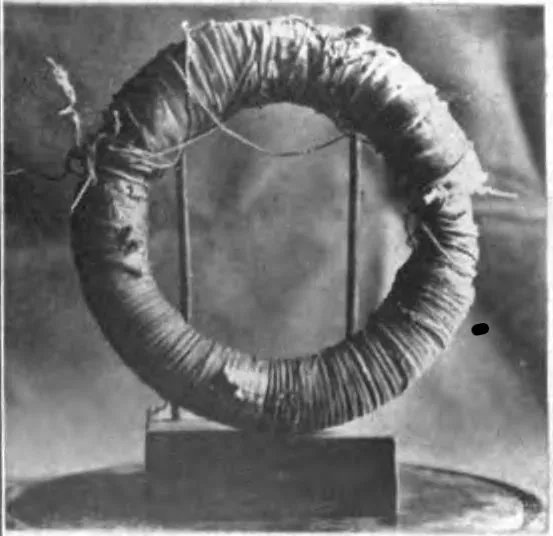
Electromagnetic field theory treats electric and magnetic action as states of a field filling space, through which forces between bodies are transmitted. In July 1820 Hans Christian Ørsted of Copenhagen announced in a short Latin paper that a wire carrying a current deflects a nearby compass needle; within months André-Marie Ampère in Paris had measured the force between two currents and given it mathematical form. Michael Faraday, a blacksmith's son, served seven years as a bookbinder's apprentice from the age of fourteen and entered the Royal Institution by way of Humphry Davy's lectures. In 1821 he made a current-carrying wire revolve around a magnetic pole. On 29 August 1831, with two coils wound on an iron ring, he found that switching a current on or off in one coil produced a momentary current in the other, and that November he reported electromagnetic induction to the Royal Society. Faraday used almost no mathematics; he pictured electric and magnetic action spread through space along "lines of force". From 1855 James Clerk Maxwell put those lines into mathematics. In "On Physical Lines of Force" (1861–62) a model of molecular vortices gave a speed for electromagnetic disturbances almost identical to Fizeau's measured speed of light; "A Dynamical Theory of the Electromagnetic Field" (1865) dropped the mechanical model and gave complete field equations, and his Treatise followed in 1873. In 1887–88 Heinrich Hertz, at Karlsruhe, generated and detected electromagnetic waves with spark gaps.
Connections
Causes2
- The CompassinspiresIn 1820 Ørsted saw a current deflect a compass needle, linking electricity and magnetism
- ElectricityinformsThe steady current of the voltaic pile made electromagnetic experiments possible
Consequences2
- ElectricityenablesFaraday's induction (1831) is the principle of the generator
- The TelegraphenablesElectromagnets and galvanometers formed the telegraph's sending and receiving apparatus
Sources
- Michael Faraday, Experimental Researches in Electricity (3 vols.) (1839–1855)
- James Clerk Maxwell, A Treatise on Electricity and Magnetism (1873)
- Olivier Darrigol, Electrodynamics from Ampère to Einstein (2000)
- Nancy Forbes, Basil Mahon, Faraday, Maxwell, and the Electromagnetic Field (2014)
Open questionswell attested
- Accounts differ on when Ørsted first saw a compass needle deflected (the winter of 1819–20 or the spring of 1820).
- The American Joseph Henry discovered electromagnetic induction independently at about the same time but published later.
- The four Maxwell equations used today are the form in which Heaviside and others restated the theory in the 1880s.
Why it matters
Electromagnetism is often cited as the case where science ran ahead of technology: Faraday's induction preceded practical generators by decades, Maxwell's equations predicted electromagnetic waves, and wireless telegraphy arrived within a decade of Hertz's experiments. Yet technology shaped the science too. The voltaic pile supplied steady currents; the failure of the first transatlantic cable in 1858 pressed physicists to study signal transmission and electrical units, and Maxwell himself worked on the British Association's determination of a standard of resistance. The conceptual change went deeper. Since Newton the basic picture had been bodies acting on one another across empty space; field theory made space itself the bearer of energy and action, a road that relativity and quantum field theory continued. Of Faraday, Maxwell wrote in the preface to his Treatise that "his method of conceiving the phenomena was also a mathematical one, though not exhibited in the conventional form of mathematical symbols."