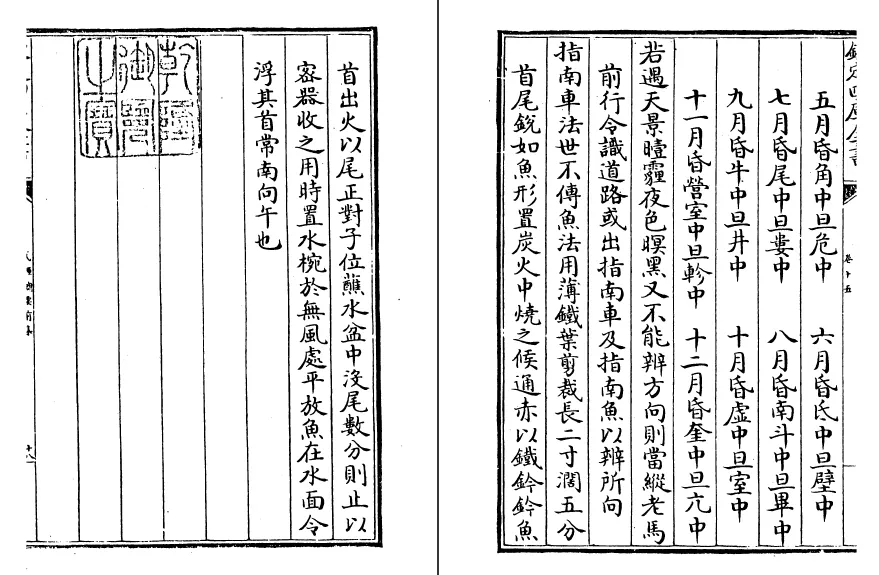
An instrument that finds direction by the orientation of a magnet. The Warring-States "south-pointing spoon" rests on thin evidence; reliable records begin under the Northern Song. The Wujing Zongyao (1044) describes a "south-pointing fish" magnetized by heating and quenching; Shen Kuo's Dream Pool Essays (c. 1088) sets out four ways of mounting a magnetic needle and first notes that it points "slightly east"—magnetic declination. Zhu Yu's Pingzhou Ketan (1119) reports Guangzhou shipmasters watching the stars by night and the south-pointing needle in overcast weather, the earliest clear notice of the compass at sea; European records appear by the late twelfth century.
Magicians rub a needle-point with lodestone, and then it can point south; yet it always inclines slightly east, not due south.
—— Shen Kuo, Dream Pool Essays, ch. 24 (c. 1088)
History
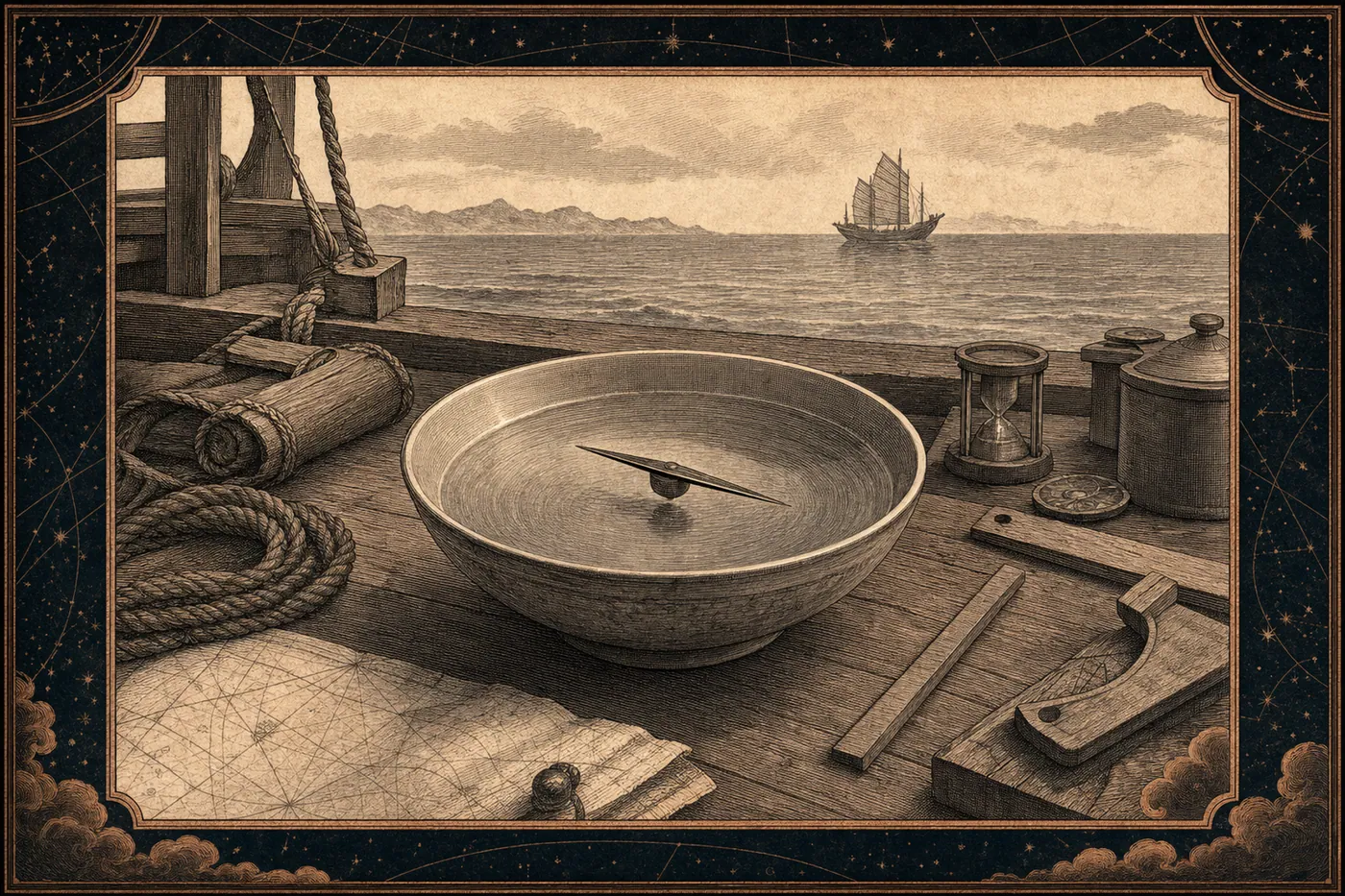
The "south-pointing spoon" of Warring-States texts is often called the first magnetic compass, but no specimen has been excavated; Wang Zhenduo's spoon-shaped reconstruction of the 1940s is conjecture, and scholars largely reserve judgement. Reliable records begin with the Northern Song. The Wujing Zongyao (1044) describes a "south-pointing fish": a thin iron leaf cut to shape, heated red and quenched so that it cools along the earth's field and acquires magnetism, then floated on water. Around 1088 Shen Kuo compared four mountings for a magnetized needle (floated, balanced on a fingernail or on a bowl's rim, and hung by silk) and judged silk suspension best; in the same passage he noted that the needle points "slightly east," the world's earliest record of magnetic declination, some four centuries before Europe. In 1119 Zhu Yu wrote that on the foreign ships of Guangzhou the pilots "watch the stars by night, the sun by day, and in murk the south-pointing needle": the compass was by then standard equipment for the open sea. By the late twelfth century Alexander Neckam in England and Guyot de Provins in France mention a floating needle; the Mediterranean world went on to build the dry compass with an attached wind-rose, which sailed with the age of exploration to the rest of the world.
Connections
Causes1
- Shen KuocontributedFirst record of magnetic declination
Consequences2
- Francis BaconinspiresOne of his three great inventions, the one he credited with transforming navigation
- Electromagnetic Field TheoryinspiresIn 1820 Ørsted saw a current deflect a compass needle, linking electricity and magnetism
Echoes2
- GunpowderechoesTwo Song-era technologies that travelled west, with no causal link between them
- Polynesian NavigationechoesTwo unrelated solutions to open-sea orientation: by instrument and by embodied perception
Sources
- 沈括《梦溪笔谈》卷二十四
- 李约瑟(Joseph Needham), 《中国科学技术史》第四卷第一分册·物理学
- History of the compass
Open questionspartly uncertain
- No spoon-shaped sinan has ever been excavated; Wang Zhenduo's reconstruction is conjectural, and many scholars doubt it.
- The south-pointing fish in the Wujing Zongyao (1044) and the magnetic needle in the Dream Pool Essays (c. 1088) are secure evidence.
- Chinese records of magnetic declination predate European ones by about four hundred years.
- Whether the compass was invented independently in China and Europe or spread west from China is unresolved, so a one-way transmission should not be asserted.
Why it matters
Shen Kuo's half-sentence about the slight eastward inclination deserves separate attention. A compass exists to give direction, yet what he recorded was the amount by which it fails—the outlook of someone treating a tool as an object of study, a quiet watershed in the history of instruments. Chinese accounts stopped at the phenomenon; not until Gilbert in the sixteenth century did anyone explain it by treating the earth itself as a lodestone, and the timing of that step has to do with institutions and with what questions were worth asking, not with cleverness. A second layer concerns users: in China one of the needle's earliest applications was siting buildings and graves, and going to sea was only one branch among many, whereas in the Mediterranean it was bound almost immediately to the chart and the wind-rose. The same object develops different uses in different societies; technology does not decide its own course.