Around the 1040s the Song commoner Bi Sheng devised reusable baked-clay type, replacing whole-block carving with rearrangeable single graphs. Because Chinese uses so many characters and clay type was fragile, woodblock printing stayed dominant in China—yet the idea of movable type kept re-emerging across East Asia and in later metal type.
For printing only two or three copies it would hardly be worth the trouble; but for tens, hundreds, or thousands, it is marvelously quick.
—— Shen Kuo, Dream Pool Essays (Mengxi Bitan), c. 1088
History
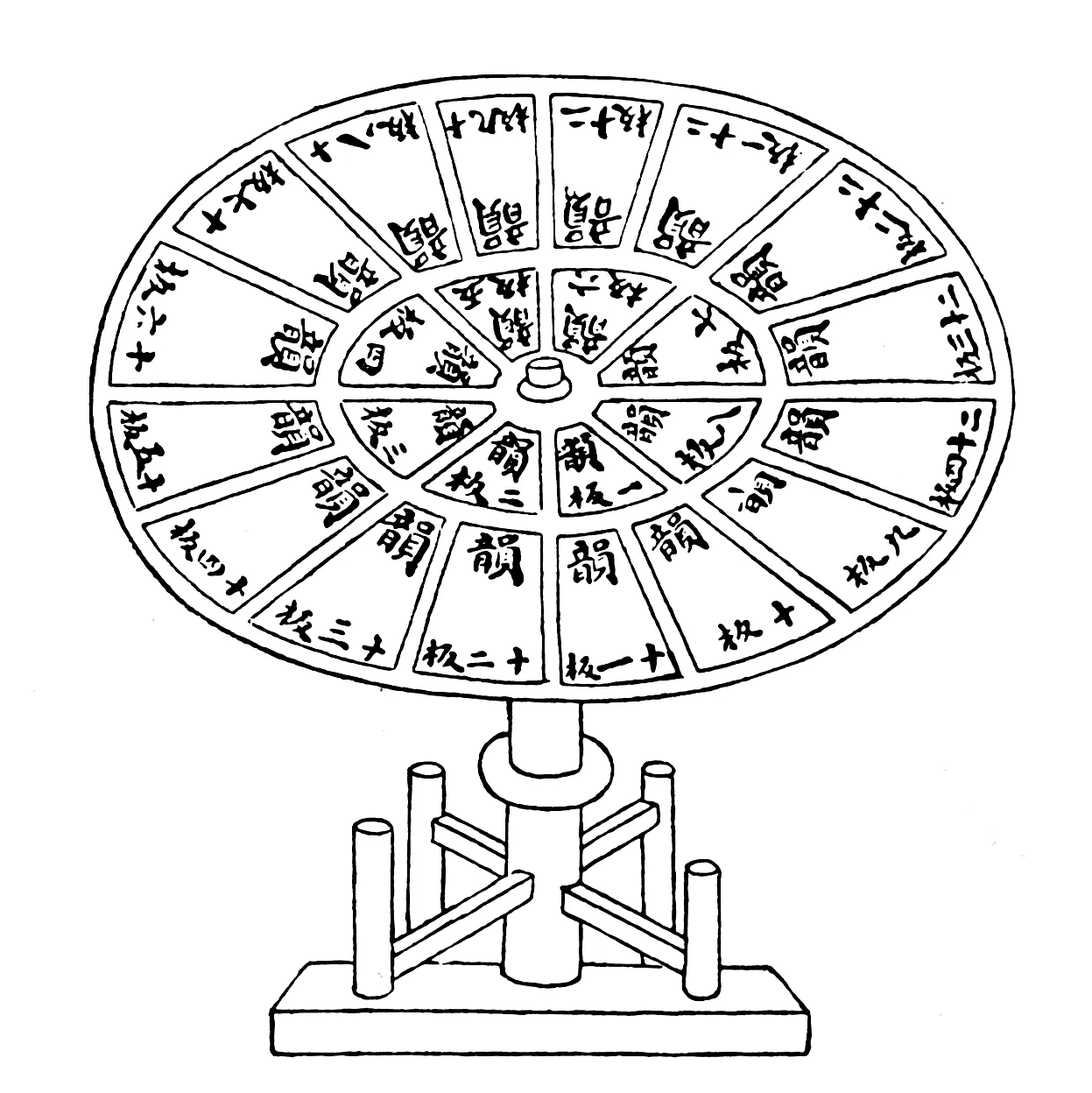
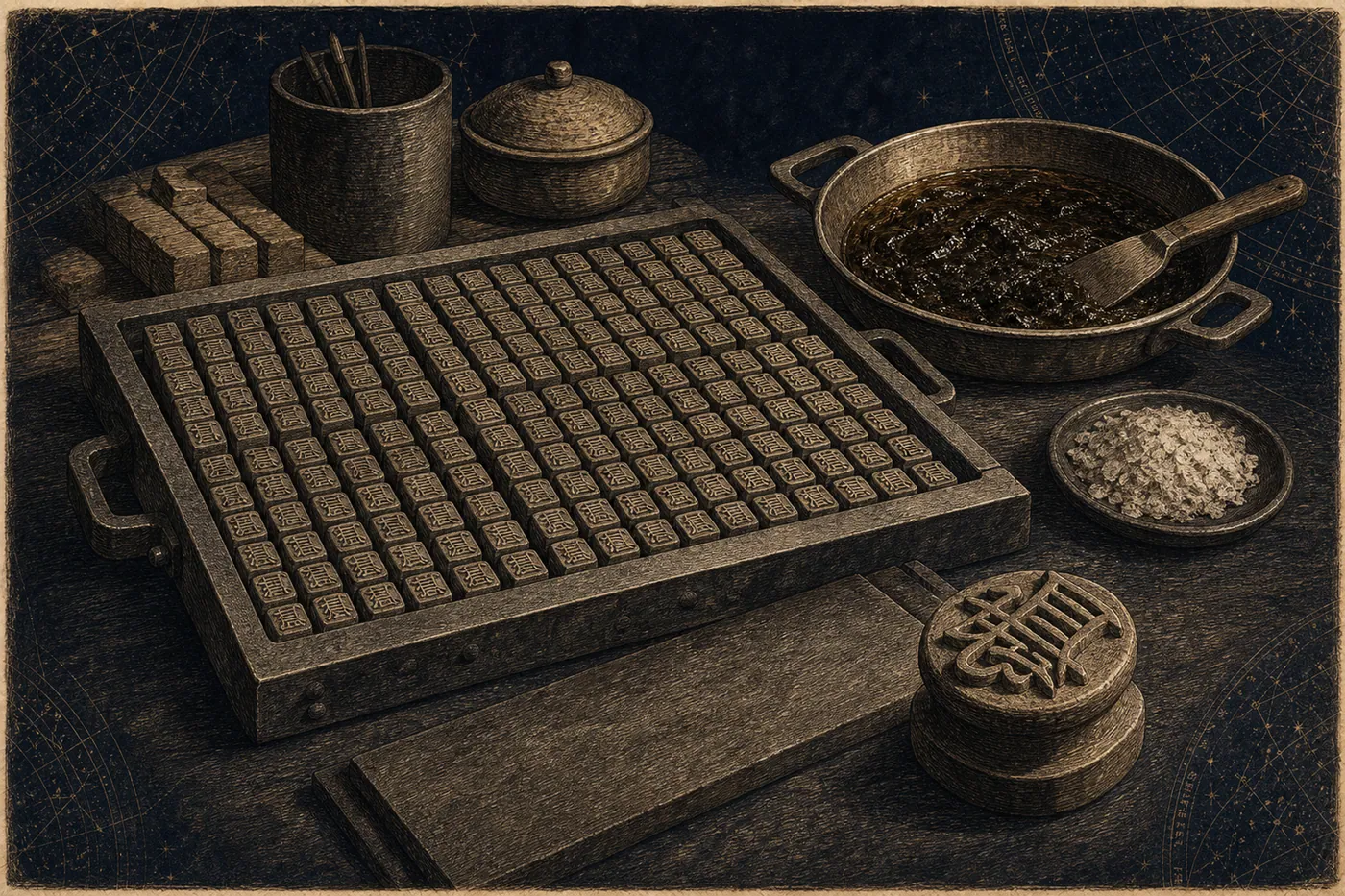
Bi Sheng was a commoner of the Northern Song whose deed survives almost solely through a few hundred characters in Shen Kuo's Dream Pool Essays. Around the 1040s he carved individual graphs in clay, each character its own piece, "thin as the rim of a coin," and fired them hard. To compose a page he spread pine resin, wax, and paper-ash on an iron plate within an iron frame, packed it with type, warmed it until the binder softened, then pressed the faces flat "as a whetstone." After printing, reheating freed the type for reuse. He kept two plates in rotation, one printing while the next was being set, so the work went "in the blink of an eye." After his death his type passed to Shen Kuo's nephews. Ingenious as it was, Chinese needed thousands of graphs and tens of thousands of sorts, and clay type was perishable; woodblock printing remained China's mainstream. Movable type would find other paths only later—Wang Zhen's wooden type (c. 1298), Ming bronze type, and the metal type of the Korean peninsula (e.g. the Jikji, 1377).
Connections
Causes3
- PapermakingenablesWithout paper there is no printing; papermaking was a precondition of movable type
- Woodblock PrintingenablesThe carving and printing techniques of woodblock printing were the technical antecedents of movable type
- Shen KuocontributedThe Dream Pool Essays is the sole near-contemporary record of Bi Sheng's type
Echoes1
- The Printing Revolutionechoes · disputedEast Asian and Gutenberg movable type arose independently; no influence between them should be assumed
Sources
- 沈括《梦溪笔谈》卷十八·技艺
- 钱存训, 《纸和印刷》(李约瑟《中国科学技术史》第五卷第一分册)
- 钱存训, 《书于竹帛》
Open questionspartly uncertain
- Bi Sheng's dates are unknown, and he is attested only in the Dream Pool Essays, a single source.
- No confirmed examples of clay movable type have been excavated.
- Whether there was any indirect transmission of knowledge between Chinese and European movable type is disputed.
Why it matters
Textbooks like to boast that Bi Sheng beat Gutenberg by four centuries, but this "world first" needs a cooler footnote. Being first to invent is not the same as being first to prevail: an alphabet opens shop with a few dozen letters, whereas Chinese must first stockpile a whole library of sorts, so half the flexibility of "movable" type is lost against the script itself. What made movable type world-changing was never the clay alone but a whole social apparatus (alphabet, paper, capital, competitive markets) that assembled in Europe only four centuries on. Movable type is thus best read as a specimen of anti-Whig history: the fate of one invention across civilizations turns on structure, not genius. Bi Sheng's and Gutenberg's movable type are generally taken to be independent inventions; claims of indirect transmission so far lack evidence.