An organochlorine insecticide. First synthesized by Zeidler in 1874, its insecticidal power was discovered in 1939 by the Swiss chemist Paul Müller (Nobel Prize 1948). From WWII it was used massively against mosquitoes and lice to fight malaria and typhus, then broadcast over postwar agriculture. Persistent, fat-soluble, and biomagnified up food chains, it devastated wildlife; the US banned its agricultural use in 1972, and the 2001 Stockholm Convention restricted it to a public-health exemption for disease-vector control.
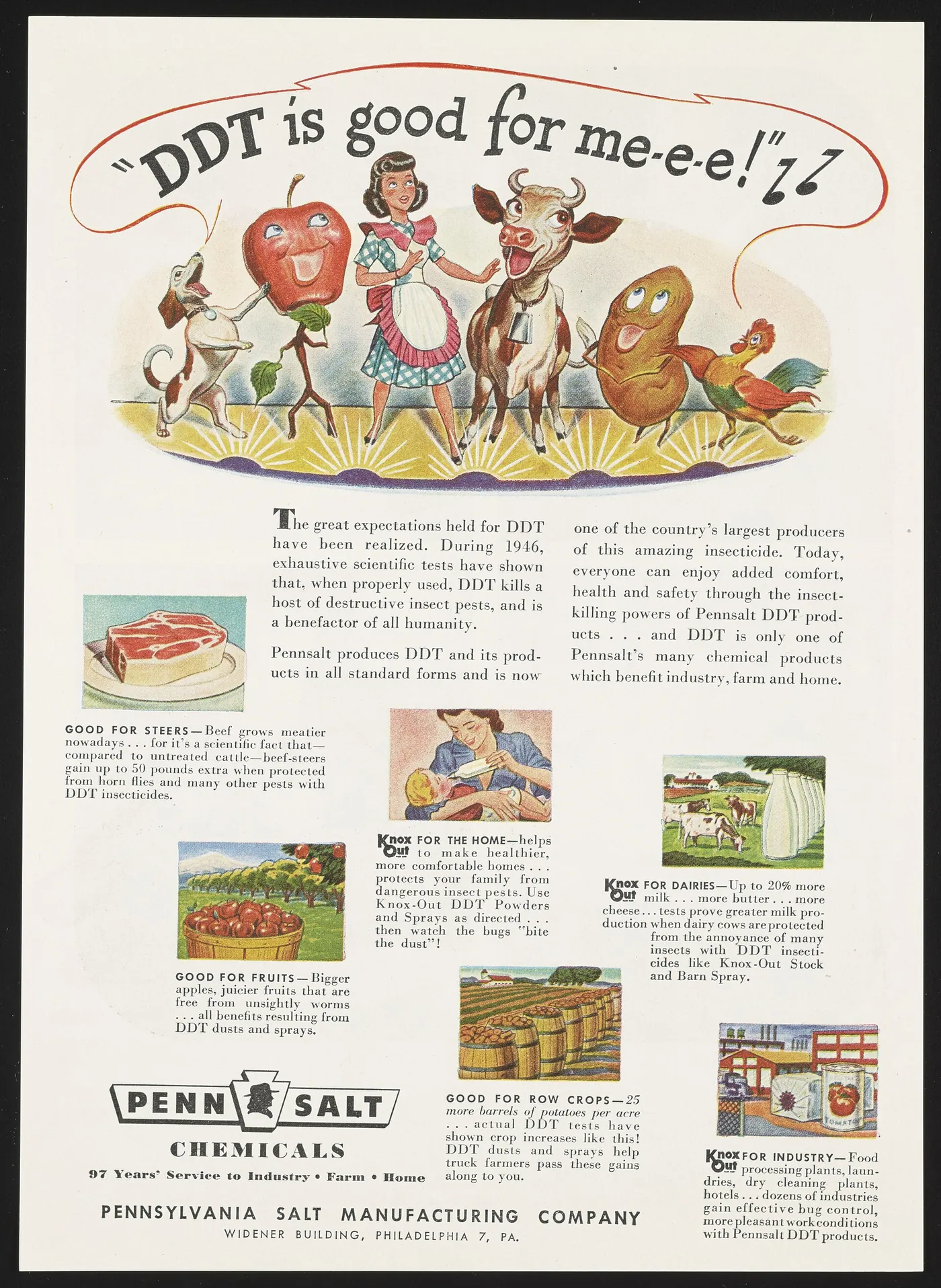
DDT is good for me-e-e!
—— Pennsalt Chemicals advertisement, Time, 1947
History
DDT (dichloro-diphenyl-trichloroethane) was first synthesized by Othmar Zeidler in 1874, but its insecticidal power was not discovered until 1939, by the chemist Paul Müller of the Swiss firm Geigy, who received the 1948 Nobel Prize in Physiology or Medicine for it. In the second half of WWII, DDT was used on a massive scale to delouse and protect soldiers and civilians (its suppression of the Naples typhus outbreak of 1943–44 made its name), and it became the mainstay of postwar malaria control. Cheap, effective, and of low acute toxicity to mammals, it was hailed as a triumph of chemistry and sprayed over fields, towns, and even children. Yet its very persistence and fat-solubility made it accumulate up the food chain. In 1962 Rachel Carson's Silent Spring sounded the alarm; in 1972 the US EPA administrator William Ruckelshaus cancelled most of its uses; and in 2001 the Stockholm Convention listed it as a persistent organic pollutant, keeping only a public-health exemption for disease-vector control.
Connections
Causes1
- Pesticide RegulationregulatesRegulation restricted and finally ended DDT's agricultural use
Consequences1
- The DDT Ecological CrisiscausesPersistence and biomagnification triggered the ecological crisis
Sources
- DDT
- Paul Hermann Müller (Nobel Prize 1948)
- Chemistry World, How DDT went from triumph to tragedy
Open questionswell attested
- Synthesis in 1874, the discovery of its insecticidal properties in 1939, the Nobel Prize in 1948, the US ban in 1972 and its listing under the Stockholm Convention in 2001 are all confirmed.
- The net trade-off between health and the environment in the use of DDT (malaria control against ecological cost) remains a matter of policy debate.
Why it matters
That 1947 slogan, "DDT is good for me," now reads like the opening of a dark fable, but to reduce DDT to a "chemical fraud" is its own kind of Whiggish shortcut. Its history is a ledger not yet balanced: on one side, the millions saved from malaria and typhus; on the other, the raptor populations it crashed and the ecological awareness it rewrote. The 1972 ban was not the moral end of the story—DDT is still used under treaty exemption in some high-malaria regions, and "how many died because DDT was banned" has itself become a politicized rhetorical question. It triggered an ecological crisis and it shaped the practice and idea of malaria control, and both entries belong in its account.