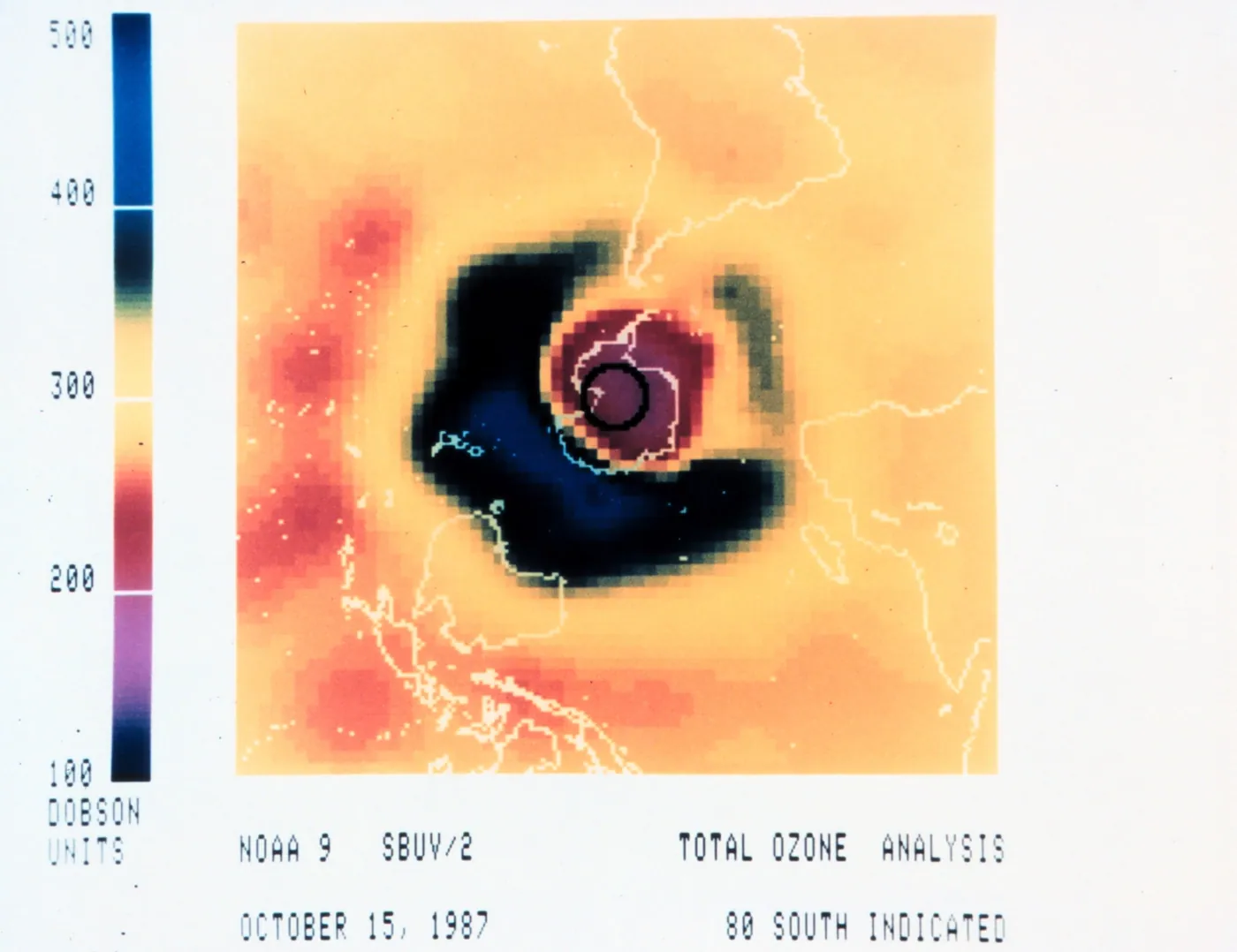
The severe depletion of stratospheric ozone by the breakdown of man-made chlorofluorocarbons, most conspicuous in the extreme spring thinning over Antarctica. Molina and Rowland gave the theoretical warning in 1974; in 1985 Farman and colleagues of the British Antarctic Survey confirmed the hole from ground-based measurements. The Montreal Protocol of 1987 and its parent Vienna Convention later became the first treaties in United Nations history to achieve universal ratification, and the ozone layer is projected to recover around the middle of this century.
The stuff is non-toxic, non-flammable, non-corrosive—and that is exactly the problem: doing nothing, it drifted all the way to the stratosphere.
—— Summarized from the reasoning of Molina and Rowland's 1974 Nature paper
History
When chlorofluorocarbons appeared in the 1930s they were a model product of the chemical industry: non-toxic, non-flammable, non-corrosive, so stable they reacted with almost nothing; hence their wide use as refrigerants, blowing agents, and aerosol propellants. In 1974 Molina and Rowland argued in Nature that this very stability let them rise undisturbed into the stratosphere, where ultraviolet light frees chlorine atoms, and a single chlorine atom can catalytically destroy tens of thousands of ozone molecules. The claim was fiercely contested, with industry calling it an unproven hypothesis. In 1985 Farman, Gardiner, and Shanklin of the British Antarctic Survey reported ground data from Halley Bay: total Antarctic ozone in spring had fallen by more than thirty percent from 1970s values. Satellite records were then re-examined—their extreme low values had been flagged for checking as beyond preset thresholds, not, as the popular account has it, discarded automatically by a computer. Once the hole was confirmed events moved quickly: the Montreal Protocol of 1987 set a phase-out schedule, successive amendments tightened it, and it eventually achieved universal ratification. By the early twenty-first century concentrations of controlled substances had begun to fall, and models project Antarctic ozone returning to 1980 levels around the 2060s.
Connections
Consequences1
- The Modern Environmental MovementinspiresThe exemplary case of environmental governance at global scale
Sources
- Mario J. Molina & F. S. Rowland, Stratospheric sink for chlorofluoromethanes: chlorine atom-catalysed destruction of ozone (Nature, 1974)
- J. C. Farman, B. G. Gardiner & J. D. Shanklin, Large losses of total ozone in Antarctica reveal seasonal ClOx/NOx interaction (Nature, 1985)
- Ozone depletion
Open questionswell attested
- The satellite (TOMS) data contained anomalous values before 1985, which were flagged for checking because they fell outside preset thresholds; the story that a computer "automatically discarded" them is a popular simplification.
- The timetable for the recovery of the ozone layer (around 2066 over Antarctica, earlier at mid-latitudes) is a model projection and is revised in the light of emissions and their coupling with climate.
- The "world avoided" scenario is the conclusion of modelling studies, not an observed fact.
- The epigraph summarizes the line of argument of the 1974 paper (it is not a verbatim quotation), as noted with the quotation.
Why it matters
Among the global disasters of modern technology, the ozone hole is a rare one that ends well, and it is worth asking why. Technically, CFCs had feasible substitutes and were made by a handful of firms, so the object of regulation was clear. Scientifically, the mechanism of harm was single, attributable, and measurable. Politically, the link between increased ultraviolet and skin cancer landed the risk squarely on voters in wealthy countries. Only with all four conditions present did the much-praised protocol become possible—a reminder that success stories are usually less transferable than people hope. The other lesson lies in the confirmation of 1985: a set of "impossible" readings from a ground station could trigger global action because someone had kept the station staffed and recorded, year after year, a variable of no evident use at the time. Monitoring is itself infrastructure, and its value becomes visible only at the moment something goes wrong. As for the tale that a computer threw the data away, the truth is duller: anomalies were flagged for checking, not discarded, though the popular version has travelled further than the fact.