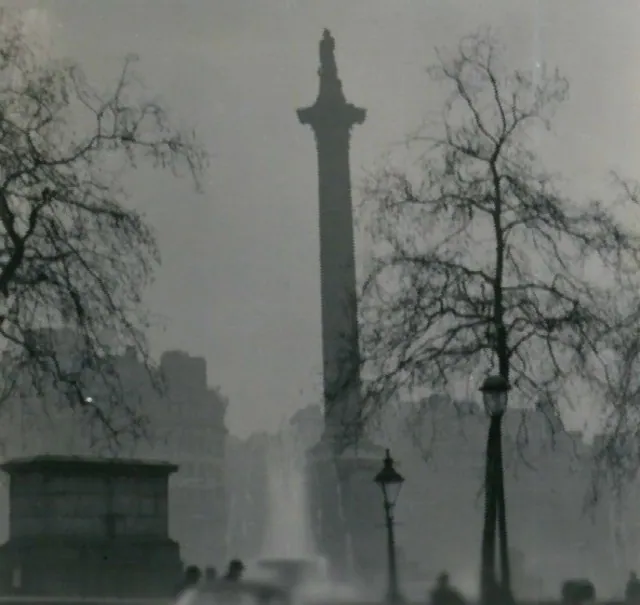
From 5 to 9 December 1952 an anticyclone brought still air and a temperature inversion that trapped the smoke and sulphur dioxide of millions of London coal fires and power stations at ground level. Visibility fell to a few metres, transport halted, and theatres closed because the stage could not be seen. Official counts at the time gave about four thousand deaths; later research revised the total to around twelve thousand. The disaster led directly to the Clean Air Act of 1956, a turning point in environmental legislation.
In the space of five days, deaths in London exceeded the seasonal norm by about four thousand.
—— UK Ministry of Health, Mortality and Morbidity during the London Fog of December 1952 (1954)
History
London's coal smoke was an old affliction: medieval decrees against burning sea-coal, and by the nineteenth century the "pea-souper" as a mark of the city. On 5 December 1952 an anticyclone settled over the Thames valley; the wind dropped and a layer of warm air capped the cold, forming an inversion. The poor-grade coal burned in millions of households (the better grades went for export after the war), together with coal-fired power stations and diesel buses, had nowhere to disperse, and sulphur dioxide and particulates accumulated near the ground, combining with moisture into an acid aerosol. Visibility fell to a few metres; buses were led by men on foot with lamps, ambulances stopped running, Sadler's Wells halted a performance because the audience could not see the stage, and cattle suffocated at the Smithfield market. Four days later a westerly arrived and the smog cleared. Hospital admissions and the queues at undertakers then revealed the cost: sharp excess mortality from respiratory and cardiovascular disease, heaviest among the old and already ill. The government at first inclined to blame influenza; under pressure it appointed the Beaver Committee, and the Clean Air Act of 1956 established smokeless zones, subsidized the conversion to smokeless fuel, and pushed power stations out of the city.
Connections
Consequences1
- The Modern Environmental MovementinspiresThe Great Smog was one of several disasters that fed the environmental movement
Sources
- UK Ministry of Health (1954), Mortality and Morbidity during the London Fog of December 1952
- Peter Brimblecombe, The Big Smoke: A History of Air Pollution in London since Medieval Times
- Great Smog of London
Open questionswell attested
- The official death toll at the time was about 4,000, while later epidemiological studies (including the argument over delayed deaths and the part played by influenza) have raised it to about 12,000; both figures are still cited.
- The Meuse Valley fog in Belgium in 1930 and the Donora smog in the United States in 1948 were earlier events of the same kind and offer points of comparison.
- The Clean Air Act 1956 did not work overnight, and London's smoke pollution did not lessen markedly until the 1960s.
Why it matters
The lesson of the Great Smog is not that pollution harms, which had been said countless times from medieval decrees to nineteenth-century cartoons, but why knowing was not acting. Londoners had lived with coal smoke for centuries; the fog was written into novels, etched into prints, treated as part of the city's character. That very familiarity filed the danger under weather rather than emissions. What changed policy was the statistical work that matched the death toll precisely to those five days: only when harm was first counted as excess mortality did it turn from an atmosphere into a fact. Silent Spring did structurally the same thing ten years later: between visible discomfort and attributable damage lies a method. The Great Smog and the DDT ecological crisis both fed the environmental movement; modern environmental governance was pushed forward by an accumulation of separately measured disasters, not opened by a single awakening.